
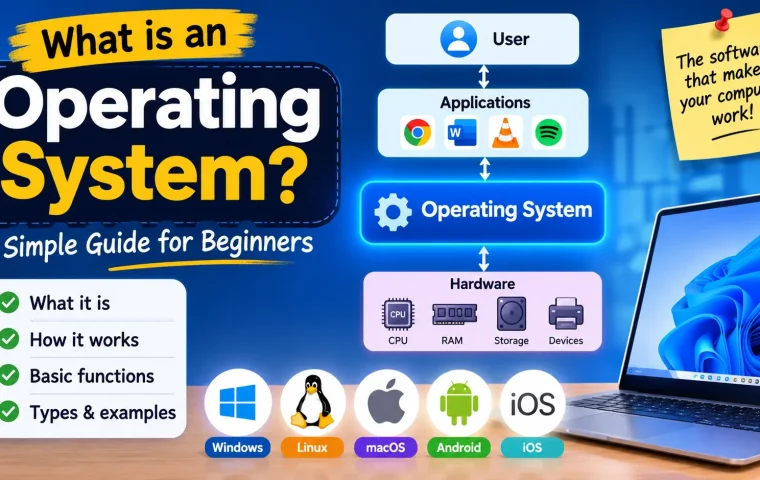
An operating system is software already being used if you have a computer, laptop, smartphone or tablet. However, what is an operating system, and what does it do?
Operating system (OS), the primary software program that controls a computer or other digital gadget. Supports the hardware and software to function together. It also provides you with a device usage option.
Some of the common examples of operating systems include: Windows, Linux, Mac OS, Android, and iOS.
For instance, an OS will carry out a variety of activities when opening a browser, saving a file, connecting to a printer, or playing a video without the user realizing it.
In this guide, you’ll learn what is an operating system, how it works, basic functions, operating system types, and examples of operating systems Windows Server, Linux, and real-time operating system.
What Is an Operating System?
In computing, operating systems are system software that control and coordinate the activities of the hardware and software of a computer.
There are numerous components that make up a computer including, the processor, the hard drive or S.D., the keyboard, the mouse, the screen, and the printer. All these components must be given instructions in order to function correctly.
These parts are handled and used by the operating system and other software.
For instance, if you’re listening to a song, downloading a file on Google Chrome. All three tasks must be accomplished simultaneously by your computer.
The operating system supports by:
- Providing the programs with access to the CPU
- Providing programs with the memory they need
- Downloading the file can be difficult.It can be challenging to manage the downloaded file.
- Receiving sound from the speakers
- Connecting with other devices via digital means, such as plug and play and network connections
- Monitoring student use of the Internet
You don’t have to do all these things on your own. Most of this is done for you by the operating system.
An operating system (OS) is the software that controls the hardware resources and provides services to applications. (IBM)
Operating Systems explained clearly for beginners.
The best way to comprehend the OS is to believe that it is a bridge among the computer hardware, your applications, and you.
Their basic construction is:
User — Applications — Operating System — Hardware
Let’s look at a very basic example.
When you start a music program and play a piece of music.
It requires access to your computer’s hard drive, RAM, processor, and computer speakers. Rather than directly manage all of these components, an application requests resources directly from the OS.
Then the operating system, handles those requests.
Thus, the operating system is like an intermediary between the application and the hardware.
Then swimming with the computer would be a lot more difficult.
What is the Function of an Operating System?
But what is the work done by an operating system?
The primary function of any operating system is to handle the resources of a computer and to run programs or applications.
Some of its primary responsibilities are:
- Managing the CPU
- Managing RAM
- Finding files and folders on remote sites via file and folder name.
- Managing storage
- Managing hardware devices
- Running applications
- Providing a user interface
- User and permission management
- Reading and writing to a file
- Supporting network connections
- Basic security features are provided :
Let’s know these functions individually.
Basic Functions of an Operating System
1. Process Management
Processes are the programs that are executing.
Each time you open Chrome, it launches one or more processes, for instance.
While this is happening, you might be running other programs that may include:
- Microsoft Word
- Spotify
- File Explorer
- Antivirus software
- A video player
The CPU is required to run all these programs.
These processes are handled and managed by the operating system and the allotment of CPU time is determined by the operating system.
This is known as a process management.
Allows you to execute a number of programs simultaneously without having to perform CPU management.
2. Memory Management
The short-term memory of a computer is RAM. Programs use RAM while they are running.
If you start your browser, your photo editor, as well as your music player, each will require memory.
The operating system maintains an account of which portion of RAM is utilized and allots RAM to the programs that need it.
It also prevents an application from interfering with memory allocated by another application.
This is known as memory management.
3. File Management
Your computer has an operating system which controls the files and folders there.
The operating system is used when you:
- Create a file
- Rename a file
- Copy a file
- Move a file
- Delete a file
- Create a folder
- Open a saved file
The operating systems also interact with the file systems. A file system determines the way in which information is organized and stored on a storage medium.
For instance, NTFS is employed in Windows while ext4 and other sorts of file systems could be used in Linux.
4. Device Management
A computer has numerous devices associated with it.
These may include:
- Keyboard
- Mouse
- Printer
- Webcam
- Speakers
- Monitor
- USB devices
- Wi-Fi adapter
- Storage devices
The operating system enables communication between these devices and the computer.
This is also accomplished by using Device Drivers. A piece of software that enables the operating system to operate with a specific hardware device.
For instance, if you connect a printer the OS will speak to it through and require the appropriate driver or built in printer support.
5. Security and User Management
Security features are also provided by ‘operating systems’.
They are able to regulate the use of the computer and the kinds of activities that users are permitted to engage in.
This means for instance, that a computer can have different accounts for different users. Some users may have software installation permissions and some users may have limited software installation permissions.
The operating systems can also supply services like:
- Password protection
- User permissions
- File permissions
- Security updates
- Encryption
- User authentication
These features serve to safeguard the system and the information in it.
6. User Interface
An operating system provides a means for the user to communicate with the computer.
There are two widely-used interfaces.
Graphical User Interface (GUI)
A GUI can support use of such as:
- Windows
- Icons
- Menus
- Buttons
- Folders
Some common examples of graphical operating systems are Windows and Mac OS.
Command-Line Interface (CLI)
A CLI is a way of giving instructions to the computer using typing.
The command-line administration is used in a lot of instances for Linux servers. In the command line window there are tools available for Windows such as Command Prompt and PowerShell.
7. Introduction to I/O Management (IOM)
The operating system is the software that controls the computer’s input, such as a keyboard, mouse, microphone and any touchscreen.
It also controls output devices like screen, speakers, and printers.
In other words, the OS sends a keystroke to the running program when you press a key on your keyboard.
8. Network Management
The majority of today’s computers have access to a network, such as the Internet.
These connections are handled by the operating system.
Cooperates with network hardware and software to enable applications to communicate with each other.
For instance, when you open a Web site, the browser will rely on network services offered by the operating system to interact with the Internet.
What is the workings of an Operating System?
Let’s now know how does an operating system work.
The operating system is the program that runs between the computer hardware and the application programs.
A prime illustration of this is:
Application – operating system – hardware.
Imagine you start a video player.
A video player requires the functions of the CPU to process the video. It performs the operations only with the help of RAM for the data during the video playback. You may require storage to read the video file. It also requires the necessity to display and voice the video through the display and the speakers.
The application requests the resources from the OS.
The operating system receives requests, and provides the application with the resources it requires.
This occurs very rapidly and is not usually noticed.
What is the kernel?What is this kernel?
One of the most crucial components of an operating system (OS) is the kernel.
It is a central element of the operating system and performing a number of critical functions including:
- CPU management
- Memory management
- Hardware communication
- Process management
- System calls
Normally the computer hardware can not be accessed directly by the applications. They interact with the operating system and many of the low level operations are handled by the kernel.
One way to memorize it is:
Core part of an operating system = Kernel
The whole operating system includes the kernel and all the other software and programs, tools, libraries and services as well as the applications.
What is the Purpose of an Operating System?
The operating system of a computer is the software that handles the hardware and allows applications to run on the computer.
Today’s computers would be much harder to use if they didn’t have an operating system.
An operating system is necessary it:
- Manages the CPU
- Manages RAM
- Manages storage
- Organizes files
- Controls hardware
- Runs applications
- Provides a user interface
- Controls user management and permissions
- Supports networking
- Provides security features
When you open a photo, for instance, you don’t have to specify to the computer where to find the photo on the drive or how to display it.
Details that the operating system takes care of.
Types of Operating Systems
There are different types of operating systems: They are made for various jobs.
The most popular ones include:
- Batch operating system
- Time-sharing operating system
- Distributed operating system
- Network operating system
- Real-time operating system
- Desktop operating system
- Mobile operating system
- Server operating system
There may be more than one use of one operating system.
For instance, Linux could be installed on an embedded device, a cloud system, a server, and a PC.
What is the definition of a Real-Time Operating System?
Real-time Operating System(RTOS): It is an operating system intended for systems which have tasks that must be performed within the allotted time.
In the majority of conventional computers, the primary emphasis is on performing a task more quickly.
It is considered to be a system in which the timing of the answer is an essential and critical aspect of the system, in addition to the answer itself.
In other words, take a machine that has to respond to a sensor within a certain period of time. A large delay could cause the machine to work incorrectly.
Real-time operating systems are typically found in:
- Industrial machines
- Robots
- Medical equipment
- Cars
- Aircraft systems
- Embedded systems
Real-time operating systems include VxWorks, QNX and FreeRTOS.
According to IBM, real-time operating systems “are designed for tasks that have specific timing requirements, and they are typically used in applications where predictable response times are crucial.” (IBM)
What is Linux Operating System?
Linux is a family of free, open-source operating systems that are based on the Linux kernel.
The Linux kernel was created by Linus Torvalds in 1991.
Linux is one of the most popular operating systems on servers, personal computers, cloud computing, embedded devices and more.
According to Red Hat, Linux is an open source OS and Linux systems are deployed in many different devices and workloads. (Red Hat)
One little and important aspect that beginner never needs to miss.
Technically, Linux is a kernel and this kernel is called Linux.
A fully fledged operating system based on the Linux operating system is typically referred to as a Linux distribution (distro).
A Linux distribution is a package of the Linux kernel and other software necessary to run the system.
Some popular Linux distributions are:
- Ubuntu
- Debian
- Fedora
- Linux Mint
- Arch Linux
- Fedora Core
What is Linux OS?
When looking at websites, or even when doing a search, you may frequently encounter the term Linux OS.
People normally use “Linux OS” to refer to an operating system based on the Linux kernel.
In a technical sense, the Linux kernel is just Linux. A Linux Distribution provides everything else to make an operating system environment: software that supplements the kernel.
As a beginner you can consider the Linux OS to be considered a Linux based operating system.
One reason for the popularity of Linux is that it is open-source and is applicable to various applications, ranging from home computers to large servers.
What Is Windows Server?
Microsoft’s server operating system.
For businesses or organizations that require to operate servers and manage network resources, apps, users, and more.
The normal version of Windows (Windows 11) is primarily used for personal computers.
Windows Server is intended for carrying out with tasks identified with servers.
It can be used for:
- Managing users
- Managing networks
- Partaking in websites and applications
- Using the file system and storing files in file servers
- Running virtual machines
- Managing security
- Providing remote access
- Running business services
A company can, for instance, manage employee accounts and computers on Windows Server by means of its Active Directory.
Some of the tools and features that Microsoft offers with Windows Server are Hyper-V, DNS, DHCP, SMB, PowerShell, or Windows Admin Center. (Microsoft Learn)
Examples of operating systems include Windows, Linux, Android, and iOS.
There are several different operating systems other than this one.
| Operating System | Common Use |
| Windows 11 | Desktop and laptop computers |
| macOS | Apple Mac computers |
| Linux | Computers, servers, cloud systems and other devices |
| Android | Smartphones and tablets |
| iOS | iPhones |
| Windows Server | Business and server environments |
| ChromeOS | Chromebooks |
| FreeBSD | Servers and network systems |
| FreeRTOS | Embedded and real-time systems |
Each operating system is for a particular kind of device or task.
Operating System vs Application Software
OS’ and apps are different.
An operating system is a program that administers a computer, and offers services upon which programs can operate.
An application is a program developed to carry out a particular function.
For example:
Windows → Operating System
Google Chrome → Application
Linux → Operating System
Microsoft Word → Application
Android → Operating System
WhatsApp → Application
An application in use will likely rely on the operating system for access to hardware and other computer resources.
A photo editing program, for instance, might request the operating system to read in a photo and display it on the screen.
Operating System or Kernel?
Sometimes people call the operating system the kernel and vice versa, but they are not the same.
The kernel is the part of an operating system that performs the basic functions of the system.
Operating system – This is the other part of the computer operating system, in addition to the kernel, which is what makes the computer useful.
For instance, in a Linux distribution, there are:
- Linux kernel
- System libraries
- System tools
- Package manager
- Depending on the version, there will be a desktop environment that can be installed.
- Any other use or service
So, a short cut memory device is:
Kernel = Core of the operating system
Operating systems can be defined as Kernel + other system software.
The gap comes real in handy when you begin to learn Linux.
ITG Academic Challenges Following the First Question What happens when you turn on a computer?
Ever wonder what happens after you hit the power button?
Before the login screen appears, there are a number of things that transpire.
The simplified form will look like this:
If you use this device, you will see it boot up as follows: Power On → Firmware Starts → Bootloader Runs → Kernel Loads → System Services Start → Login/Desktop Appears.
First, computer’s basic hardware is checked and the computing firmware is started.
The computer then searches for the software it requires to boot up the operating system.
During bootup, those who bring up the accumulator are loaded by the bootloader.
Kernel begins to control CPU, memory, devices and other resources.
Other system services then start and the login screen and/or desktop eventually appears.
The exact process may vary from one device and/or operating system to another.
`Operating System’ means an important system.
Operating systems are helpful because they enable various components of a PC to function jointly.
A computer could contain a CPU, RAM, SSD, graphics processor, Wi-Fi adapter, keyboard, mouse, speakers and lots more.
Use of these resources will be required in applications.
These are controlled by the operating system.
For instance, if you are streaming a video and downloading something and are surfing the web, the operating system will handle the resources that those tasks require.
Get rid of the manual CPU, RAM, storage and hardware management.
One of the primary reasons why we need operating systems is that.
Frequently Asked Questions
In simple words what is an operating system?
The primary software program which runs a computer system and coordinates its hardware resources is referred to as an operating system. Examples are Windows, Linux, macOS, Android and iOS.
What is the function of an operating system?What are the operating system’s functions?
The operating system controls the CPU, memory, storage, files, hardware devices, applications, users, and other resources of the system.
Yes, it is an OS.Yes, it is an Operating System.
Yes. An operating system built by Microsoft Windows. It is a program that’s much used in desktop and laptop computers.
What is Linux operating system?What is meant by Linux operating system?
Linux is a family of open-source operating systems, using the family of Linux kernels. Distributions like Fedora, Ubuntu and Debian are complete operating systems.
What is the Windows Server?What does the Windows Server mean?
Microsoft’s server operating system is called Windows Server. It is created to enable businesses and organisations to extend applications and to manage user, storage, network, along with other server services.
A real time operating system is?
A real-time operating system (RTOS) is an operating system which is designed for systems requiring tasks to be performed within a certain time limit. Commonly used in industrial, automotive, medical, robotics and embedded systems.
Put on the functions of an Operating System in simple words.Explain the basic functions of an Operating System in simple words.
Process management, memory management, file management, device management, security, user management, input/output management, network management are the basic functions.
What is the working of Operating system?
Operating system is a programme which performs an intermediary function between application and hardware. Applications make requests for resources in the OS, which is in charge of them and interacts with the hardware.
Name one or two examples of operating systems.State some examples of operating systems.
This includes Windows, macOS, Linux, Android, iOS, ChromeOS, and real-time OS like FreeRTOS etc.
An operating system’s primary function is to?
The primary function of an operating system is to manage hardware resources and give the applications a system to operate on.
Final Thoughts
Main Software used to help a computer or digital device function: Operating System.
It is the one which takes care of the CPU, RAM, storage, files, hardware devices, applications, users, and other resources.
The simplest approach to keeping this in mind is:
Application ← Operating System ← Hardware ← User
Personal computers are often filled with computers running Windows and macOS operating systems. Computers, servers, cloud systems and many more devices are powered by Linux. Windows Server itself is designed to be used with servers and businesses. REAL TIME OPERATING SYSTEMS: When a system must respond to tasks with some specified time frame, realtime operating systems are used.
Once you know what an OS does, many other areas about computers are quite easy to learn, such as Linux, Windows Server, networking, cloud, virtualization, and cybersecurity, to mention a few.


Leave a Reply
You must be logged in to post a comment.