

If you have searched for a product, service, software, course, or business on Google, you have probably seen paid advertisements in the search results. These advertisements are a common example of PPC advertising, which businesses use to reach potential customers online.
So, what is PPC? PPC stands for Pay-Per-Click. It is a form of paid advertising where an advertiser pays when someone clicks on an advertisement. Businesses use PPC marketing to bring targeted visitors to their websites, generate leads, increase sales, receive calls, and promote their products or services.
Google Ads is one of the most popular platforms for PPC advertising, but PPC is not limited to Google. Businesses can also advertise through Microsoft Advertising, Facebook, Instagram, LinkedIn, and other platforms.
One of the main advantages of PPC is speed. SEO can take months to build organic visibility for competitive keywords, while a PPC campaign can start bringing paid traffic much sooner after the ads are approved.
However, PPC is not simply about getting clicks. A successful PPC campaign should bring the right visitors and turn some of those visitors into leads, customers, bookings, or sales. That is why businesses need to understand how PPC works before they start spending money on paid advertising.
In this guide, we will explain what PPC means, how PPC advertising works, the different types of PPC ads, PPC costs, the difference between PPC and SEO, how to start a PPC campaign, common PPC mistakes, and frequently asked questions about PPC.
Key Takeaways
PPC stands for Pay-Per-Click and is a paid advertising model used to bring visitors to a website, landing page, product page, or other online destination.
Google Ads is one of the major PPC platforms, but businesses can also use platforms such as Microsoft Advertising, Meta, and LinkedIn.
PPC can bring traffic faster than SEO, making it useful for businesses that need quick visibility, leads, sales, or traffic.
The cost of PPC is different for every business. Keyword competition, industry, location, audience, bidding strategy, ad quality, and other factors can affect the cost of a click.
A campaign with many clicks is not always a good campaign. Leads, sales, conversion rate, cost per acquisition, and revenue are often more useful when measuring PPC performance.
PPC and SEO have different strengths. PPC can provide faster paid traffic, while SEO can help a website build organic traffic over time.
What Is PPC?

PPC means Pay-Per-Click, an online advertising model where businesses pay for clicks on their advertisements.
The basic idea behind PPC is quite simple. Instead of waiting for people to find your website through organic search, you can pay an advertising platform to show your advertisement to people who may be interested in your product or service.
For example, imagine that you provide digital marketing training. You want to reach people searching for a course online. You could create a PPC campaign targeting keywords related to digital marketing training.
A person searches Google for “digital marketing course online.” If your campaign is eligible for that search, your advertisement may appear in the paid results.
The person sees your ad and decides to click it. Under a CPC-based campaign, you may be charged for that click.
The visitor then reaches your website or landing page. From there, they might fill out an enquiry form, call your business, buy a course, or simply leave the website.
This last part is very important.
PPC does not become successful simply because people click your ads. The traffic needs to be useful to your business.
For example, imagine two campaigns. The first campaign receives 1,000 clicks but produces only two enquiries. The second campaign receives 400 clicks and produces 20 enquiries. The second campaign may be much more valuable even though it receives fewer visitors.
This is why PPC marketing should focus on the complete path from advertisement to conversion rather than looking at clicks alone.
PPC Meaning
The PPC meaning is directly connected to its name: Pay-Per-Click.
Under a CPC-based advertising model, an advertiser pays when someone clicks an advertisement. The amount paid for each click can vary depending on the platform, campaign, keyword, competition, targeting, and bidding method.
For example, suppose a business spends ₹20,000 on a PPC campaign and receives 400 clicks.
Its average cost per click would be:
₹20,000 ÷ 400 = ₹50 CPC
But CPC is only one part of PPC performance.
Suppose those 400 visitors generate 20 enquiries. The average cost per enquiry would be ₹1,000.
Now imagine that five of those enquiries become customers. If each customer generates ₹15,000 in revenue, the campaign has generated ₹75,000 in revenue from ₹20,000 of advertising spend.
This example shows why PPC marketers look beyond CPC. A low-cost click is useful only if it has a reasonable chance of producing a useful result.
A Quick Real-World Example
Let’s take an online shoe store.
The business wants to sell running shoes and decides to run a PPC campaign on Google. It targets a search such as “buy running shoes online.”
A customer searches for that phrase and sees the store’s advertisement. The ad tells the customer that the store sells running shoes and directs them to a product page.
The customer clicks the ad and the business pays for the click.
Suppose the click costs ₹30 and the customer purchases a pair of shoes worth ₹3,000.
The business has spent ₹30 to bring that visitor to its website and has generated a ₹3,000 order.
But not every click will produce a sale. Some visitors may compare products, some may leave immediately, and some may come back later.
The business therefore needs to look at the overall campaign performance. It needs to know how much it spent, how many people clicked, how many purchased, and how much revenue came from those customers.
This is the basic idea of PPC advertising.
How Does Pay-Per-Click Advertising Actually Work?
To understand how PPC works, it helps to look at what happens between a person searching for something and an advertisement appearing in front of them.
For search advertising, the platform runs an ad auction when there is an opportunity to show an advertisement. Google considers several factors when deciding which ads are eligible and where they can appear. These include the bid, ad quality, landing page experience, competition, and the context of the search.
This process happens very quickly.
The advertiser does not simply pay money and reserve a fixed position on Google. Instead, the campaign enters the advertising system whenever it is eligible to compete.
Step 1: The Advertiser Creates An Ad
The first step in a PPC campaign is deciding what you want to advertise and what you want people to do after seeing the ad.
A business may want to generate leads, sell a product, receive calls, get registrations, or send visitors to a particular page.
For a search PPC campaign, the advertiser also needs to select relevant keywords.
Suppose a company offers cloud computing training. It may target keywords related to AWS training, Azure training, Google Cloud training, or cloud certification courses.
The advertiser then creates ad copy that matches the selected keywords.
The landing page is also important. If someone searches for “AWS certification training” and clicks an advertisement about AWS training, sending that person to a page specifically about AWS training makes more sense than sending them to a general homepage.
The campaign also includes settings such as location, budget, audience, bidding strategy and other targeting options.
Step 2: The Auction Happens In Milliseconds
When someone performs a search, Google checks the advertisements that are eligible to compete for that search.
This is known as the ad auction.
A common misunderstanding is that the advertiser with the highest bid automatically gets the top position. Google does not decide ad position based only on the bid.
The platform considers several factors, including the bid, ad quality, landing page experience, competition, and the context of the search.
This means an advertiser cannot simply solve every PPC problem by increasing the bid.
Suppose one company has a very high bid but an advertisement that does not closely match the search. Another company may have a lower bid but a much more relevant advertisement and landing page.
The second company can still compete strongly.
This is one reason PPC campaign structure and relevance matter so much.
Step 3: Your Ad Shows Up, Or It Doesn’t
After the auction, the platform decides which advertisements can appear.
Your ad may appear in a prominent position, appear lower in the results, or not appear for a particular search.
This can change from one search to another.
For example, an advertisement can perform differently in different cities because competition and search behaviour can vary by location. The same campaign may also behave differently on mobile and desktop.
This means you should not judge a PPC campaign based on one search or one day of performance.
The campaign needs to be monitored over time so you can see which keywords, locations, audiences and advertisements are producing useful results.
Step 4: You Pay Only When Someone Clicks
In a CPC-based PPC campaign, the advertiser pays when someone clicks the advertisement.
However, the actual cost of a click does not necessarily equal the maximum amount the advertiser has set.
For example, if you set a maximum CPC of ₹100, it does not mean every click will cost ₹100.
Your actual CPC can be lower depending on the auction and campaign conditions.
Over time, you can calculate the average CPC and compare it with your conversion data.
If the average CPC is ₹80 but your campaign generates customers at a profitable cost, the campaign may be working well.
If the CPC is only ₹20 but almost nobody converts, the low CPC does not mean much.
Types Of PPC Ads
There are several types of PPC advertising, and each one works differently.
Search advertising is useful when people are actively looking for something. Display advertising can help businesses reach people while they browse websites. Shopping ads are designed around products, while social media advertising can help businesses reach specific audiences.
The right type of PPC ad depends on the business and the goal of the campaign.
Search Ads (Google & Bing)

Search ads appear when people search for products, services, information, or businesses.
For example, someone might search for:
“PPC agency in Delhi”
A PPC agency targeting that search may be able to show an advertisement to the person.
Search PPC is useful because the user has already taken an action by searching.
Someone searching for “buy office chair online” has a different level of intent from someone searching for “types of office chairs.”
The first person may be closer to making a purchase, while the second person may still be researching.
Understanding this search intent helps businesses choose better keywords and write more relevant advertisements.
Display Ads
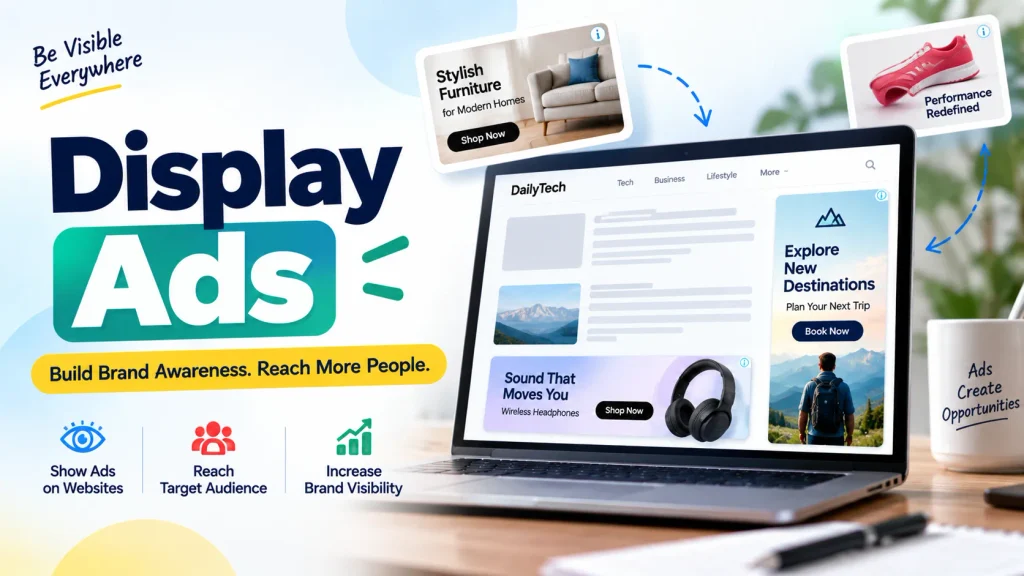
Display ads are visual advertisements that can appear on websites and apps.
Unlike search ads, display ads do not always depend on a person actively searching for the product.
For example, an online clothing store can use display advertising to show its products to people who have visited the website before.
Display PPC can also be used to increase brand awareness and reach new audiences.
The message needs to be easy to understand because the person may not be actively looking for the product at the time they see the advertisement.
Shopping Ads
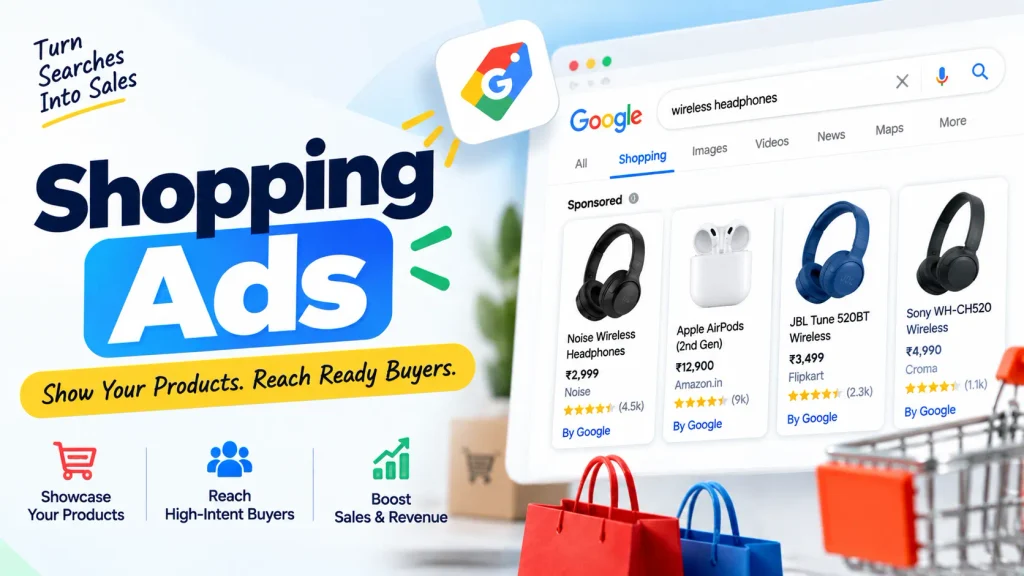
Shopping ads are mainly used by online stores that sell physical products.
These ads can show product information such as the product image, name, price, and store.
For example, a person searching for “wireless headphones under ₹5,000” may see several product advertisements.
The shopper can compare the products before deciding which one to click.
This makes shopping advertising useful for e-commerce businesses because the user can see important product information before visiting the website.
Social Media Ads

Businesses can also use paid advertising on social media platforms such as Facebook, Instagram and LinkedIn.
Social PPC is different from search PPC because the user may not be actively looking for a product.
For example, a person scrolling through Instagram may see an advertisement for a new clothing brand. They were not searching for the brand, but the advertisement may create interest.
Social media ads can be targeted using the audience options available on each platform. Depending on the platform and campaign type, businesses may be able to use information such as location, interests, professional details, previous interactions and other audience signals.
This makes social advertising useful for products and services that can attract attention through visual content or audience targeting.
Remarketing Ads
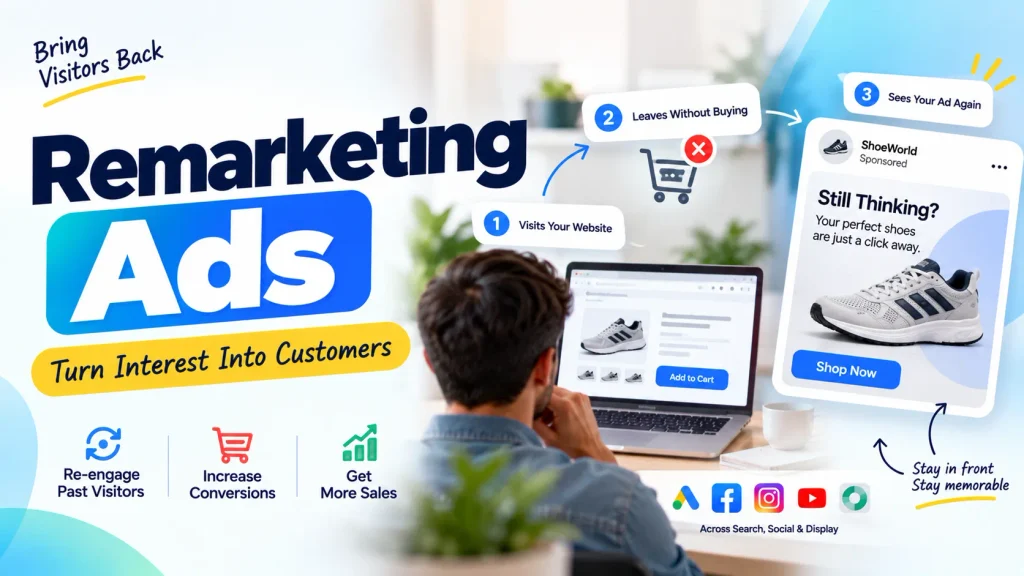
Remarketing ads are used to reach people who have already interacted with a business.
Imagine that someone visits your website and looks at a particular product but does not buy it.
Later, that person may see an advertisement from your business while browsing another website or platform.
The goal is to remind the person about the product.
Remarketing can be useful because these people have already shown some interest in the business.
However, the campaign should be set up carefully. Showing the same ad too many times can annoy users and waste advertising money.
Key PPC Terms You Need To Know
When you start working with PPC, you will see several terms in your advertising account.
CPC (Cost Per Click) is the amount you pay on average for a click. CPC is one of the most common PPC metrics.
CTR (Click-Through Rate) tells you how often people click your ad after seeing it. If an ad gets 100 clicks from 2,000 impressions, the CTR is 5%.
Impression means that an advertisement was shown.
Conversion is an action that you want the user to take. It could be a purchase, enquiry, registration, phone call, booking or another action.
Conversion Rate shows the percentage of clicks that result in conversions. If 100 people click an ad and 5 complete the desired action, the conversion rate is 5%.
CPA (Cost Per Acquisition) shows the average advertising cost for getting one conversion.
ROAS (Return On Ad Spend) compares attributed revenue with advertising spend. If you spend ₹10,000 on ads and generate ₹40,000 in attributed revenue, your ROAS is 4×.
Quality Score is a Google Ads diagnostic measure related to the quality and relevance of certain keyword and ad combinations.
Ad Rank is used by Google to determine whether an ad is eligible to show and its position compared with other eligible ads. The auction considers several factors, not just the amount of the bid.
What Are The Benefits Of PPC Marketing?
PPC marketing can give businesses a faster way to reach potential customers online.
One of the main benefits is that you do not always have to wait for your website to rank organically before getting traffic. If your campaign is approved and eligible to serve, your advertisements can start appearing for relevant searches.
PPC also gives advertisers a lot of information. You can see which searches produced clicks, which advertisements received attention, and which campaigns generated conversions.
This information can help you make better marketing decisions.
Immediate Traffic, Unlike SEO
SEO can be very useful for long-term growth, but it usually takes time.
A new page does not automatically reach the first page of Google as soon as it is published. Depending on the keyword and competition, it can take months to build meaningful organic visibility.
PPC works on a different model.
If you have a new service that you want to promote quickly, you can create a PPC campaign and start reaching potential customers much sooner.
For example, an education company launching a new course may use PPC to promote the course while its SEO content is still gaining rankings.
This does not mean PPC is always better than SEO. It simply means the two channels have different timelines.
Highly Targeted Reach
One of the strongest features of PPC is targeting.
Depending on the platform and campaign type, you can control factors such as the keywords, location, audience, device and other available settings.
Consider a local business that operates only in Delhi.
It may not make sense to show the same advertisement to people across India. The business can create a campaign that focuses on the areas where it can actually serve customers.
The same principle works for other businesses.
A B2B company may focus on a specific type of professional audience. An online store may promote specific products. A training company may target people searching for particular courses.
Good targeting helps reduce irrelevant traffic and gives the advertising budget a better chance of reaching useful visitors.
Full Budget Control
PPC also gives businesses control over how much they want to spend on advertising.
You can set campaign budgets and change them as the campaign produces more data.
For example, imagine that you are running two campaigns.
The first campaign spends ₹10,000 and generates 100 enquiries.
The second spends ₹10,000 and generates only 20 enquiries.
If the enquiries are of similar quality, the first campaign may deserve more budget.
You can use this data to make changes rather than spending the same amount on every campaign.
However, having budget control does not mean that PPC will automatically produce a return. Your keywords, advertisements, landing pages, targeting and offer still have a major effect on results.
Measurable ROI
PPC is useful for businesses that want to measure their advertising.
You can track impressions, clicks, CPC, conversions, conversion rate, cost per lead, cost per acquisition and revenue when the required tracking is set up correctly.
This makes it easier to identify problems.
For example, a campaign may have a good CTR but a poor conversion rate.
That tells you that people are interested enough to click the ad, but something may be stopping them from taking the next step.
The problem could be the landing page, offer, price, form, audience, keyword or another part of the customer journey.
Without conversion tracking, these problems are much harder to identify.
Brand Visibility, Even Without A Click
PPC advertisements can also help people notice your brand.
A person may see your advertisement but decide not to click it. Later, they may remember your company and search for it directly.
This type of brand exposure can support other marketing activities.
However, impressions should not be treated as the same thing as leads or sales. If your main goal is performance, you should still focus on the actions that matter to your business.
How Much Does PPC Advertising Cost?
The answer to “How much does PPC cost?” depends on the campaign.
There is no single PPC price that applies to every business.
The cost can change based on the keyword, competition, industry, location, audience, campaign type and bidding strategy.
A keyword that costs ₹30 in one market may cost much more in another market.
The value of the customer also matters.
If one customer is worth ₹50,000 to your business, you may be able to spend more to acquire that customer than a business selling a ₹500 product.
Average CPC By Industry In 2026
PPC benchmarks can be useful, but they need to be read carefully.
WordStream’s 2026 Google Ads benchmark research analyzed more than 13,000 US-based search advertising campaigns running from April 2025 through March 2026. Its overall averages were a 6.64% CTR, $5.42 CPC, 8.18% conversion rate and $66.69 cost per lead.
These figures represent US search advertising campaigns. They should not be used as fixed PPC prices for Indian businesses.
The same research also shows that campaign performance varies between industries. For example, the reported average conversion rate for Education & Instruction was 13.14%, while Finance & Insurance was 2.64%.
This difference shows why businesses should be careful about using one industry benchmark to judge every PPC campaign.
A better approach is to use benchmarks as a reference and then compare them with your own campaign data.
What Affects Your PPC Cost?
Keyword competition is one factor that can affect PPC cost.
If many advertisers want to appear for the same commercial keyword, the competition can be strong.
Search intent also matters.
Someone searching for “what is PPC” is mainly looking for information.
Someone searching for “PPC management agency” is much closer to looking for a service.
These two searches may have very different commercial value.
Location can also affect PPC cost. The competition and customer value can be different in different cities, states and countries.
Your advertisement and landing page can also affect your performance. Google considers ad quality and landing page experience as part of its advertising auction.
Your bidding strategy matters as well. Different strategies are designed for different goals, so the right choice depends on what you want the campaign to achieve.
How To Think About Budget If You Are Just Starting Out
Instead of copying another business’s PPC budget, start with your own numbers.
Suppose you sell a service for ₹30,000 and decide that spending ₹3,000 to acquire one customer is acceptable.
Your website has a 5% conversion rate, which means roughly one out of every 20 visitors becomes a customer.
You would then have:
₹3,000 ÷ 20 clicks = ₹150 target CPC
This does not mean that you should expect every click to cost ₹150.
It gives you a basic way to understand your advertising economics.
Once the campaign starts running, you can replace these assumptions with real data.
If your actual conversion rate is lower than expected, your target CPC may need to change. If your customers are more valuable than expected, you may have more room to spend.
PPC Vs SEO: Which One Is Better?
PPC and SEO are often compared because both can help businesses get traffic from search engines.
The main difference is how that traffic is obtained.
PPC uses paid advertising.
SEO focuses on improving a website’s organic visibility.
Both can be useful, but they are suited to different situations.
PPC vs SEO At A Glance
| Factor | PPC | SEO |
| Traffic source | Paid | Organic |
| Speed | Usually faster | Usually slower |
| Payment | Advertising spend | No payment for each organic click |
| Control | High control over paid campaigns | Less direct control over rankings |
| Long-term traffic | Depends on continued advertising | Can continue from strong organic rankings |
| Main use | Fast traffic, leads, sales and testing | Long-term organic growth |
When To Choose PPC
PPC is useful when speed matters.
Suppose you have launched a new service and want to generate leads this month. Waiting for an SEO page to rank may not fit your timeline.
PPC can also be useful for testing.
You may be considering whether a particular keyword has enough commercial value to justify a larger SEO campaign. Running a PPC campaign can give you real search and conversion data much faster.
PPC can also work well for seasonal products, limited-time offers and services where people already have strong buying intent.
When To Choose SEO
SEO is useful when you want to build organic traffic over time.
A strong page can continue to attract visitors from search engines without paying for every organic visit.
SEO can be especially useful for businesses that have many questions, topics and problems that their target audience searches for.
For example, a cloud training website could create content around certification costs, exam preparation, career options, course comparisons and interview questions.
These pages can build organic visibility over time.
SEO still requires investment in content, technical work, website improvements and other activities. It is not a free source of traffic.
Why Smart Businesses Use Both
PPC and SEO can work together.
PPC can help you get quick traffic and learn which keywords, offers and messages generate results.
SEO can help you build organic visibility around important topics and searches.
For example, a company selling Google Cloud training could use PPC to target high-intent searches such as “Google Cloud certification training.”
At the same time, its SEO strategy could target searches such as “Google Cloud certification cost,” “Google Cloud certification guide,” and “Google Cloud career opportunities.”
The PPC campaign can help with immediate demand, while SEO can help build a longer-term source of traffic.
How To Start A PPC Campaign: Step By Step
A PPC campaign should be planned before the first advertisement is written.
The first question should be what you want the campaign to achieve. Once that is clear, you can decide where to advertise, which keywords to target, what message to use and how much you can afford to spend.
Step 1: Define Your Goal
Start with one clear goal.
You may want to generate leads, increase sales, receive calls, get course registrations, collect enquiries or drive product purchases.
For example, an e-commerce company may measure purchases and revenue.
A service company may focus on qualified leads.
A local business may care more about phone calls and appointment bookings.
Your campaign settings and conversion tracking should match the goal.
If your goal is lead generation but you only track clicks, you will not have enough information to judge the campaign properly.
Step 2: Choose Your Platform
Choose the PPC platform based on your audience.
Google Ads can be useful when people are already searching for a product or service.
Microsoft Advertising can provide another search advertising option.
Meta advertising can be useful for businesses that want to reach people through Facebook and Instagram.
LinkedIn can be useful for certain B2B campaigns where professional targeting is important.
You do not need to use every platform.
Start with the platform that gives you the strongest chance of reaching the right audience.
Step 3: Do Keyword Research
Keyword research is a major part of search PPC.
You need to understand what your potential customers are searching for and what those searches tell you about their intent.
For example, a company offering PPC services could target a specific search such as “PPC management services for small business.”
That search gives more information about the user’s needs than simply targeting “PPC.”
You should also research negative keywords.
Negative keywords help prevent advertisements from appearing for searches that are not useful to your business.
For example, a paid training company may decide to exclude searches containing “free” if it does not provide free training.
Good keyword research can help you avoid paying for visitors who are unlikely to become customers.
Step 4: Write Your Ad Copy
Your PPC ad should match the user’s search and clearly explain what you are offering.
Avoid vague statements that could apply to almost any business.
For example:
“Best Service At Great Prices. Contact Us Today.”
does not give the user much useful information.
A more specific advertisement might say:
“Google Ads Management For Growing Businesses”
followed by a description that explains the service, main benefit and next step.
The landing page should support the same message.
If the advertisement promises Google Ads management but the landing page talks mainly about general digital marketing, the visitor may not find what they expected.
Step 5: Set Your Budget And Bids
Your PPC budget should be connected to your business numbers.
Think about your average customer value and the maximum amount you can reasonably spend to acquire that customer.
Google Ads provides different bidding strategies designed for different campaign goals. Some focus on clicks, while others can focus on conversions or conversion value.
For a new PPC campaign, the goal should be to collect enough useful data to understand what is working.
Do not increase the budget simply because the number of clicks is increasing.
Look at whether those additional clicks are producing leads, sales or other useful results.
Step 6: Track And Optimize
A PPC campaign should be checked regularly after launch.
Look at the searches that are triggering your ads. Check which keywords are receiving clicks and which ones are producing conversions.
Also check the landing pages.
If your ads receive many clicks but very few enquiries, the problem may be the landing page rather than the advertisement.
You may need to change the keywords, add negative keywords, test different ad copy, improve the landing page, change your targeting or adjust the bidding strategy.
This is why PPC management is an ongoing process.
The first version of a campaign is rarely the final version.
Common PPC Mistakes To Avoid
One of the most common PPC mistakes is sending every visitor to the homepage.
A homepage usually covers the entire business. A person who clicks a PPC advertisement normally has a specific need.
If someone searches for “Red Hat Linux training,” a landing page specifically about Red Hat Linux training is usually more relevant than a general company homepage.
Another mistake is ignoring negative keywords.
A keyword may look relevant when you add it to your campaign, but the actual searches can show that people are looking for something completely different. Reviewing search terms helps you find these unwanted searches and exclude them.
Some businesses also launch PPC campaigns and then stop checking them.
PPC requires regular attention because competition, search behaviour and campaign performance can change.
Conversion tracking is another major issue.
If you only measure clicks, you may think a campaign is doing well because it has a high number of visitors. But those visitors may not generate any business.
You should know which campaigns, keywords and advertisements are producing leads or sales.
Another mistake is targeting too many broad keywords at the start.
Broad keywords can bring a lot of traffic, but that traffic may not always match your offer.
It is usually better to understand your main search terms and customer intent before expanding the campaign.
Generic ad copy can also reduce performance.
An advertisement should explain what you offer and give the user a clear reason to visit your website.
Finally, do not judge a PPC campaign only by CPC.
A cheap click is not always a valuable click.
A ₹20 click that produces nothing is not necessarily better than a ₹100 click that produces a qualified customer.
The right PPC strategy is about getting useful customers at a cost that makes sense for your business.
FAQ: People Also Ask About PPC
Q: What Is PPC In Digital Marketing?
PPC in digital marketing refers to paid advertising where advertisers pay for clicks under a CPC-based model.
It is commonly used to bring visitors to websites, landing pages, product pages and other online destinations.
Google Ads is one of the best-known platforms for PPC advertising, but businesses can also use other advertising platforms.
PPC can be used for search advertising, display campaigns, shopping ads, social media advertising and remarketing.
Q: How Much Should I Spend On PPC As A Beginner?
There is no fixed PPC budget for every beginner.
The right amount depends on your business, product price, customer value, target market, competition and expected conversion rate.
A small business should start with an amount it can afford to test and learn from.
The goal is not to spend as much as possible. The goal is to collect useful data and understand whether the campaign can generate leads or customers at an acceptable cost.
Once you know which keywords and campaigns are producing good results, you can decide whether increasing the budget makes sense.
Q: What Is A Good CPC?
There is no single CPC that is good for every PPC campaign.
A good CPC depends on the value of the customer and the conversion rate of the campaign.
For example, a ₹100 CPC may be reasonable for a business that sells a high-value service if those clicks regularly produce customers.
The same CPC may be too expensive for a business selling a low-priced product.
Instead of looking only at CPC, compare it with conversion rate, cost per lead, cost per customer, customer value and ROAS.
Q: What Is The Difference Between PPC And Google Ads?
PPC and Google Ads are not the same thing.
PPC is an advertising model, while Google Ads is an advertising platform.
Google Ads supports PPC advertising, but PPC is not limited to Google.
Other platforms also provide paid advertising options that can use click-based bidding or other pricing and optimization models.
Conclusion
So, what is PPC?
PPC stands for Pay-Per-Click and is a form of paid online advertising that businesses use to reach potential customers.
The basic PPC process starts with creating an advertisement and choosing the right targeting. The advertisement then enters an auction when there is an eligible opportunity to show it. If someone clicks the ad in a CPC-based campaign, the advertiser pays for that click.
But good PPC advertising is about more than getting clicks.
The keyword needs to match the user’s search. The ad needs to explain the offer clearly. The landing page needs to give the visitor the information they expected. Conversion tracking needs to be set up so the business can see whether the traffic is producing leads, sales or other useful actions.
PPC can be a good choice when a business needs traffic quickly, wants to promote a new product or service, or wants to test search demand.
SEO has a different role. It can take longer, but it can help a website build organic traffic over time.
For many businesses, PPC and SEO work better together. PPC can provide quick traffic and useful data, while SEO can build a longer-term source of organic visitors.
If you are planning to start a PPC campaign, begin with a clear business goal. Work out how much a lead or customer is worth, choose keywords that match your audience, create relevant advertisements, and send visitors to focused landing pages.
Then track the results and improve the campaign based on real data.

Leave a Reply
You must be logged in to post a comment.