
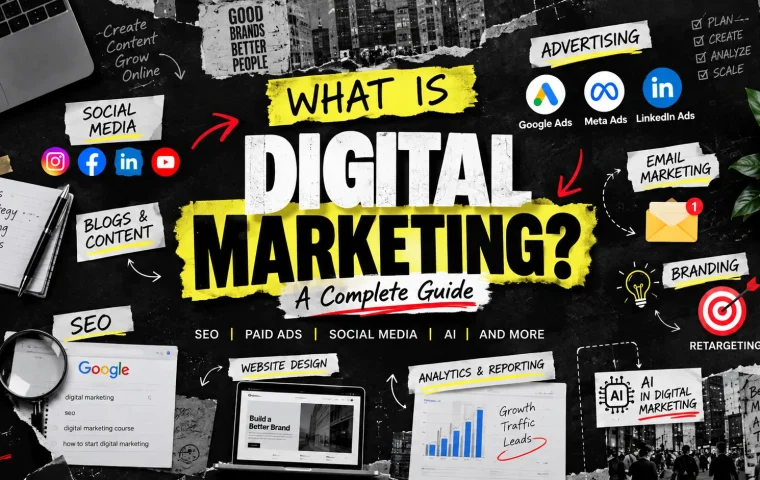
What is Digital Marketing?
Digital marketing has been established as a significant component of nearly all businesses. From a small local business to an online store, a software company, a training institute, a personal brand or a large company, all can utilize digital marketing to reach out to their customers.
However, digital marketing isn’t all about sending ads out through Google and posting pictures on Instagram. It features a lot of activities like SEO, content marketing, social media marketing, Google Ad, Meta Ad, LinkedIn Ad, email marketing, SMS marketing, competitor research, local SEO and more.
What follows is the meaning of all the major components of digital marketing in simple English. It also offers information on using AI in SEO and content creation, how to leverage Google Search Console, how to analyse competitors, paid advertising, and even how to build a pro resume with AI.
The goal is to gain an understanding of digital marketing from the ground level and then take the steps towards the practical level. The information topics and approach in this article may be derived from the Training transcript which was made available.
What Is Marketing?

There is a need first to comprehend marketing and then digital marketing.
Marketing is the act of putting the product in the hands of individuals who might want it, such as a product, service, person, company or brand.
For instance, if a company sells laptops. Cnn the company must make people aware of its LAPTOPS. Can describe characteristics, warranty, cost of operation, price, etc. The company attempts to ensure that potential customers will understand the value in buying the product.
That is marketing.
Products aren’t the only thing that can be marketed. A service may be marketed as well. An individual may be marketed also. For instance, a celebrity might have a team of public relations personnel who works on their image and representation to the public. The team can interview, publish articles, create posts on social media and other activities which can help with the person’s public profile.
The simple concept is that you have something you want people to know, and you’ll reach people in different ways.
What Is Digital Marketing?
Digital marketing is any marketing that is done online and/or through digital devices.
So, when a company markets its URL via Google Search, it’s digital marketing.
Digital marketing is the promotion of a company’s products that take place online, such as through Instagram or Facebook.
Digital marketing is also established if a business is using Google Ads, YouTube Ads, display ads and so on.
Digital marketing can also include email marketing and SMS marketing.
Thus, Digital marketing isn’t one activity. It’s an integration of various methodologies that are used to market a business, product, service or brand digitally.
The most popular digital marketing channels are search engines, websites, social media, paid advertising, video advertising, display advertising, emails, and SMS.
You will also come across an internet marketing. In many circumstances, both terms are utilized the identical way. Terms can vary, but for a digital marketer, it’s about how the marketing action happens and what is the outcome generated.
Why is Digital Marketing necessary for business?
Businesses have a number of motivations to shift into digital marketing.
A road-side hoarding, for example, is a traditional method of advertising (that you do not want to go in for), and you comprehend online advertising by understanding how that works.
Suppose a company has invested ₹ 1 lakh on a hoarding erected in a crowded locality. The business does have visibility, but there are constraints to who sees the ad or doesn’t.
Let’s assume that the target demographic is female between the ages of 18 and 30. Normally, the advertising information hoarding can be displayed only to hoard that group. It will be seen by people of all ages and interests.
Next look at a digital advertising campaign.
Many digital advertising platforms allow you to target for such things as age, location, interests, language, and audience signals. This provides a tremendous amount of control to the business that the ad gets seen to.
The amount of ₹1 lakh is nothing more than an illustration. In not all scenarios is digital marketing cheaper. It varies depending on the business, competition, audience and platform, and many more.
Better Targeting
Targeting is one of the best benefits of digital marketing.
Now imagine that you are the provider of an online course for working professionals. You don’t want to reveal the advert to everyone.
With digital advertising, you can select a particular audience based on the options available on the platform.
There’s also another form of targeting you can get by way of SEO. That’s when these pages can be built and instead of someone randomly seeing an ad, they can see the page that is based on a search they’re already doing and that your potential customers are searching for.
For instance, if the people are looking for “furniture shop in Bangalore”, a furniture company can do SEO for that kind of search.
The goal is to connect with individuals who will be more inclined to want exactly what you have to offer.
Wider Reach
Location-based option is a limitation of traditional advertising.
Anyone with a hoarding in one area would have most visibility from those traversing the area.
Digital marketing enables you to gain access to people across various cities, states and countries.
While a business might have customers in the UK, USA, Canada, Australia or elsewhere, it can conduct an online campaign for which those customers.
This can be helpful for companies who intend to branch to several areas.
Better Control Over Spending
Digital campaigns provide marketers with greater control over their campaigns.
There is a financial limit one can begin with, which they can check and tweak as per the results they see.
When a campaign is not going well, it can be temporarily halted. An audience, creative, message and other settings can also be changed.
Many traditional advertising techniques do not allow for such flexibility.
Measurable Results
A significant difference is in measurement.
If a hoarding is erected. Although you have an idea of the volume of your traffic, you may not be able to measure the number of people who saw the ad, recalled it, or took action to become customers later after seeing the ad.
Digital marketing provides you with a lot more data.
Information like impression, clicks, website visits, conversions, cost per result and more campaign data can be viewed depending on the platform and tracking set up.
This data can then be utilized for the subsequent campaigns’ enhancements.
That’s why digital marketing is sometimes referred to as data-driven marketing.
Flexible Campaigns
There is the ability to modify digital campaigns while they are in progress.
You can stop a campaign, restart it, make adjustments to the budget, refresh the targets of your audience, make updates to your ad or create a new version.
This helps testers test your site.
A marketer may experiment with different headlines, pictures, video content, visitors, landing pages and offers, then make a remark on the outcomes.
Retargeting
Digital marketing also ensures businesses can get in touch with those who are already acquainted with them.
Others may come in view your website but not purchase anything, for instance.
You could, of course, show that person another ad later, if you’re tracking and setting up your platform correctly.
This is known as retargeting or remarketing.
Depending on the platform and privacy guidelines, it is also possible to build audiences based on users who have interacted with your content, visited specific pages, or made purchases.
This will provide marketers with an alternative communication channel with interested prospects.
Organic Marketing and Paid Marketing
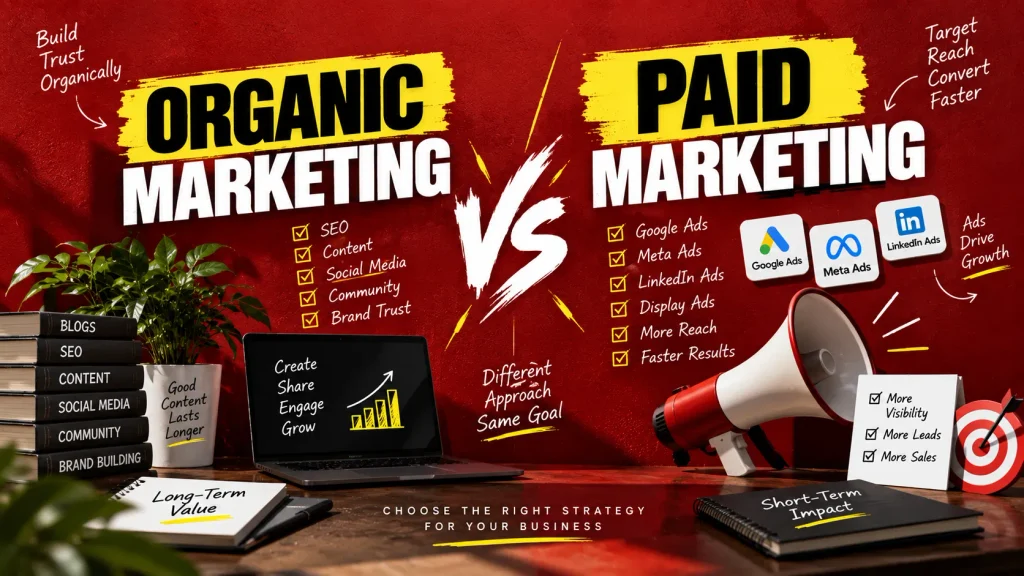
Digital marketing can be broadly understood using two frequently used terminologies – organic marketing, and paid marketing.
Organic marketing is simply gaining attention that isn’t paid directly for per impression or click.
If you made changes to your website and it suddenly begins to appear on Google’s organic search page, then the traffic you get from Google’s search page is organic.
When you post on a website or social media profile, it can help you with organic traffic and engagement.
Paid marketing is not the same.
Here the amount that you pay is the platform that presents your ad for you to the targeted viewers.
Popular examples include Google Ads, Meta Ads, LinkedIn Ads, display advertising, and video advertising.
Both of these methods are valuable. It will depend on the company, goal, target market, finances, and timelines.
What Is SEO?
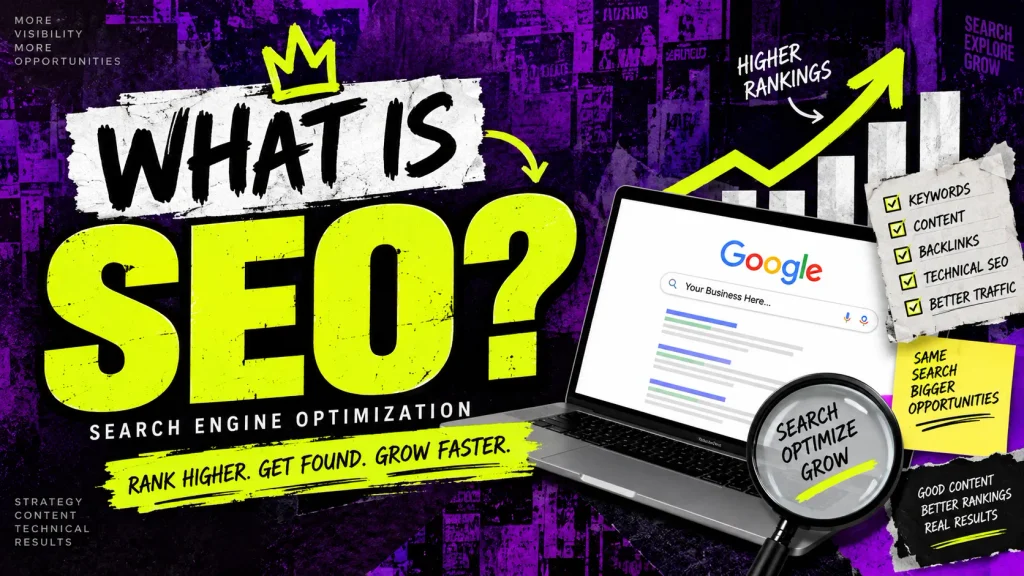
SEO is an acronym for Search Engine Optimization.
SEO involves making changes to a website and pages with the aim of providing the website a better position in search engine results.
If you want to learn SEO, it’s better if you will take a good example.
If you are looking for a furniture shop in Bangalore, you can follow the above three steps to pick the right furniture company. You type in ‘Furniture Shop in Bangalore’ on google.
There are lots of results that Google might show.
There could be hundreds, thousands or even millions of furniture-related pages. Yet, you won’t open all of the results.
There’s a good chance that most people will glance at the results that appear to be useful and pertinent to what they search.
That’s why companies think it is essential to have a website which ranks well for relevant keywords.
SEO efforts are essentially the activities that you undertake in order to make your website easier for search engines to comprehend and find using various search queries.
So what is the role of SEO in Business?
SEO can help to improve the likelihood of a website appearing high up in the results of organic search.
If the site is displayed for the correct search queries, then there is the potential for attracting increased traffic to the site.
That traffic can be of better quality when the site is showing up for search queries from people who were interested in the product or service in the first place.
For instance, someone searching for “running shoes” probably isn’t as useful for a running shoe store as someone searching for “buy running shoes online.
SEO is typically a lengthy process.
It’s not usually a technique that you follow for a short while and get a bunch of visitors the next day. It needs research, content work, technical improvements, links, testing and checking.
A transcript also shows SEO as a long procedure and will help develop believe in the business when it is commonly showing up in relative search results.
On-Page SEO
On page seo is the one conducted on the internet site and the internet pages.
This entails anything relevant to the content, layout of the page, HTML tags, links within the page, URLs, etc.
Also the transcript has technical problems in its on page SEO check list. You might have some of the SEO professionals who see the technical SEO as an altogether different thing.
It’s not so much who the groups are as knowing what should be looked at and improved on a site.
You can use the checklist for various websites, such as business websites, blogs, ecommerce websites, coded websites and CMS websites.
Content Quality for SEO
One of the significant sections of SEO is content.
A website should have sufficient information to discuss the subject adequately.
For a blog, this could be a lengthy post which does a proper post of the topic.
For a business site, it can be the services, product, benefits, process, “Frequently Asked Questions,” and other information that might be needed by a visitor.
A reasonable rule of thumb for the amount of detailed content in the transcript is the use of 500 to 1,000 or more words. This is not a hard and fast set of Google rules! Unfortunately there’s no magic number of words that will guarantee rankings.
The focus is that it should not come across as being basic description and because there, but it should explain the subject.
When creating a service page such as website development, for instance, the text “We offer website development services” isn’t exactly informative.
A more informative page would take a person from you don’t know where that a page begins to what it is, how you do it, what technologies you use, what features you might have, what industries you might have a page for, what the types of questions are asked, and basically anything else this person might like to know.
How much content to use is based on how much information must be conveyed on the page.
Keyword Density
Keyword density refers to the frequency of a specific keyword in the content.
For instance, if you’re using “SEO course” as your primary keyword.
If a particular phrase is used several times in an write-up, its keyword density will be higher.
The transcript takes 2% to be the practical limit and states that the recommended percentage is significantly less in the case of the detailed piece of content, on which the word “SEO course” occurs 18 times.
This 2%, however, doesn’t necessarily represent a Google requirement — it is more of a suggestion by the transcript.
The best way is to write naturally.
When the same keyword is repeated throughout every sentence, the reader will have trouble reading the content.
Don’t repeat phrases like “online SEO course” on the page—just use other words that are related to this, including SEO training, SEO classes, on page SEO training, off page SEO training and other phrases that naturally fit the context.
You can use a keyword density checker to review the page, but reading it can also be important.
If it seems like the content is being repeated, it needs to be worked on.
Plagiarism and Duplicate Content.Plagiarism/Duplicate content.
Plagiarism is defined as not being original or did not seek permission for someone else’s work.
Marketers, or content writers can check content before it is posted by using plagiarism-checking tools.
The tools that are mentioned in the transcript are Grammarly, QuillBot, Small SEO Tools, and DupliChecker.
It also says that its content should be more than 50% unique, and who would choose 60% as a realistic figure.
The percentages are to be interpreted as an indication of the working recommendation of the transcript and not as a rule which applies to all search rankings.
The whole point of it is to make valuable content of your own and not copy another website’s content.
Checking AI-Generated Content
While AI tools can speed up the writing process, it’s important for the content to still be checked.
ContentScale is cited as a tool for checking through sections of content that “may sound like the computer or AI-generated.”
The process just mentioned is simple.
First, copy a part of the text, and verify it using the tool. When sentences with a “robotic” tag are encountered, reread the sentences and rewrite them more naturally.
For instance, in place of writing:
“SEO is an essential element for digital marketing.”
You can write:
“SEO is an integral section of digital marketing.
The second sentence is easier to understand and more natural sounding.
The larger message isn’t just “please make AI content ‘pass’ a detector. AI might offer suggestions for research, ideas, outline, and first draft; always have content evaluated by an individual knowledgeable about the topic.
Meta Title and Meta Description
meta title and meta description are used to tell the search results what a web page is about.
Users should be able to see from the page title that this is about.
For instance, if the page is dedicated to an SEO course, the topic of the page should be apparent by the use of the title.
Metadescription helps the visitors to get a brief idea of what they are going to find at the page.
The transcript suggests considering the primary keyword, ensuring that the title and description remains relevant, verifying the length of the title and description, and manually editing AI-generated drafts.
The length of the display in Google is changeable as per the device and search result. Therefore, don’t think of this as one number of characters or pixels as a rule; it’s better to write the title and description to be clear and useful and test it out.
The title and description on each of the important web pages should also be defined as useful and different for each web page rather than same text throughout the site.
URL Structure
A URL should be simple and easily understandable.
If a page pertains to an seo training course, the URL ought to state that.
Where possible, steer clear of unnecessary (or extraneous) words, random numbers, or confusing URL structures.
A clean URL also provides clarity to the user about the content of the page before he opens it.
Using AI in SEO
An AI can assist SEO experts with a lot of activities.
It can be used to find some website research, keywords, content ideas, content drafts, competitor research, reporting and possible link building opportunities.
That said, AI must be deployed as an aid to, rather than a replacement for, humans.
The numbers should be examined, the site understood, the competitors analyzed, and a final determination made by an SEO expert to what needs to be done.
AI for Website Audits
SEO tools can provide an analysis of the website and are able to discover various forms of issues.
Technical SEO issues can be found using tools like Semrush or SEOOptimer consisting of pages, links, images, crawling, page speed, and other factors.
AI can also aid in elucidating such reports in layman terms.
For instance, a technical report can have lots of problems. An SEO expert will not have to read all the technical jargon without any context, as AI will be able to afford some indication of what it entails and what kind of action might be required.
There must still be someone who’s very familiar with SEO and the website, to verify the final decision.
AI for Keyword Research.AI for Keyword Research.
Keyword research is another part where AI can assist you.
You can provide AI with information about your business and request it to offer you suggestions on keywords.
If you have an SEO training company, for instance, then you may ask for longtail keywords such as SEO training courses, SEO training classes for novices, SEO course, etc.
AI can quickly generate numerous ideas.
However, it doesn’t stop there.
You need to use these keywords with SEO tools and consider search volume, competition, search intent and relevance.
Even if the keyword looks promising, it could be of no actual benefit to the business.
AI for Content Creation
AI can generate ideas, article outlines, article structure, article drafts, FAQs, article supporting materials and everything else.
When you’re blessed with a long content strategy and require numerous tips, it can be particularly helpful.
But if pages are important, these should be reviewed by someone who is knowledgeable on that subject.
AI can generate content that is technically accurate but lacks factual information or is unfit or simply too broad for a business.
This still means there’s a need for human review.
Know how to utilize AI for backlink and competitor research.Understand how to use AI for backlink and competitor research.
There are websites that link to competitor businesses, and competitor backlink research can help to identify them.
You’re, say, a training business and you’re doing search engine optimisation for yourself.
View a competitor’s site, find out their backlinks and discover sites linking to the competitor themselves.
Then you can have a look at those sites and determine what sites might be worthwhile for your link building project.
While AI can assist with structuring and decoding substantial information for this research, manual verification of every backlink opportunity is advisable.
Only links to ‘sources’ that are relevant and trustworthy are useful.
SEO Reports using AI.AI-powered SEO Reports.
SEO experts must generate reports all the time, whether to their client or within their in-house team.
These reports might contain keywords, web traffic, crucial pages, technical issues, and performance data, amongst other information.
There’s a lot of information there and AI can be used for summarization to make it easier to understand.
The reports can be generated on a monthly, 15-day or on a frequency as per the client and project.
What’s important is that the report should give information on what happened, why it happened, and what should be done next.
Google Search Console
Google Search Console is one of the several vital tools that an SEO expert may possess.
It facilitates website owners to know where their website stands in Google Search.
It can display details on the search queries, pages, countries, devices, search appearance, and more search-related data.
Setting Up Google Search Console
In order to utilize Search Console you will first need to add your site as a property to the tool.
Google offers other verification options.
One of them is Domain verification, which typically requires a DNS record addition.
Another is URL-prefix verification, in which you verify a certain version of the web site.
The verification can be performed, for example, via HTML tag or HTML file, based on the arrangement.
Installation of HTML tag is done using website header or you can add it to your WordPress site by using appropriate SEO plugins.
If it’s a coded website, the developer can add the validation code straight.
Performance Report
One of the most helpful sections in Search Console is the Performance section.
You can see the queries that are resulting in impressions and clicks.
You can also view which pages are getting indexed, the country your visitors are from, and the type of devices your visitors are using.
If, for instance, your page receives a lot of impressions with few clicks, this could show that your page titles may be lacking or the presentation of your page in the search results needs improvement.
Optionally you can compare dates and export data to make reporting.
This renders Search Console invaluable for SEO functions and reporting to customers.
URL Inspection
The URL Inspection tool allows you to inspect an individual page.
You can specify a page URL for which you want information related to its occurrence in Google.
This may be useful if you want to check a new page, or if you’re trying to learn about why and how a specific URL was indexed.
Sitemap Submission
A Sitemap is a method by which search engines find out what the important pages of a website are.
Once a sitemap has been built, they can be submitted on Google Search Console.
This is particularly handy when you have a new website or many pages on the website.
Other Search Console Features
Other sections of Search Console include Core Web Vitals, security, removals, settings and more web information.
It can also be used by an SEO professional to determine if Google has any issues accessing or comprehending sections of a website.
What is Local SEO?
When the business is looking to serve the people of a particular area, then they use local SEO.
It is particularly great for business entities that have clients in a specific local area like salons, restaurants, stores, photographers, offices, clinics, providers or any other business entities.
For instance, someone might serach for “salon near me” or “Delhi photographer.
A company or service based within the area needs to be found when someone does this type of search.
Local SEO is not to indicate that a business can’t reach customers outside the city.
Depending on that company’s goals, they can go local, National or International with their SEO.
Finding Local Competitors
The first step towards that is usually to identify companies that already rank for local searches.
You can visit Google and look for the service + location and learn more about the businesses which come up.
You can also enquire from the client what they think are their biggest competitors.
It can be helpful to distinguish directory websites from true competitors.
For instance, a listing site might show up in the search results but not be a competitor to the business.
Finding Competitor Listings
A basic way is to make use of the competitor’s name in addition to the city.
This can help you identify sites where the competitor has listed his or her business.
Then, you can research the appropriate business directories and community sites and determine what they’re worth to your company.
Information about a business should be consistent throughout the listings.
This includes the name of the business, address and phone info. This is called NAP (Name, Address, and Phone Number) information in local SEO.
What is Competitor Analysis?
Competitor Analysis is gaining insights into what other companies are doing in your market.
It’s not a matter of trying to do everything that a competitor is doing.
The aim is to gain a better insight into the market, potential ideas that you can utilize, to observe what works and the areas you can improve in your business.
Competitor research may include websites, SEO, traffic sources, social media and paid advertising.
Website Competitor Analysis
There are a number of metrics that you can explore on a competitor website, including keywords, backlinks, traffic sources, content and page structure, authority-based metrics, paid keywords and rankings.
It is also possible to categorize the keywords under separate categories.
For instance, a competitor can get to place for keywords incorporating the business name.
It can also be on par with non-brand keywords which tell about a product or services.
Their commercial keywords can indicate that visitors are seeking a product or service and might be more likely to take action.
It is also possible to determine if competitors are bidding on special search results elements.
Different tools like Semrush or Similarweb can assist with various aspects of this research.
Google itself is another very useful tool – the target keywords are put into Google, and you will see which businesses are cropping up.
Analysing social media isn’t straightforward.Social media analysis is not simple.
Website research isn’t enough to do competitor research.
Additionally, it’s crucial to examine their social media.
Here you can see how many followers they have, their likes, how many comments they receive, how many views they get on their videos, their engagement rate, how often they post, and what content they post.
You should also consider their content over time.
One competitor could be running lots of educational reels, while the other might be creating customer testimonials and product videos.
You can also look through some data and growth trends with public accounts using social media platforms like Social Blade.
The idea is to make sure you have an understanding as to what kind of content is gaining attention and exactly how much you can leverage within your business.
Paid Competitor Analysis
You can also learn what’s going on in the paid ads of the competitor.
This can vary from analyzing their ad content, keywords, landing pages, sales offerings and what kinds of ads they seem to be using.
Certain tools like Semrush can give you details about the activity of paid competitors, at least if they’ve shared the information.
This can help you know why competitors are ads for consumers on paid search.
What Does Strategic Marketing Involve?
Marketing is not about just “making” an ad and regular posting it.
First steps of creating a good marketing plan is the Business Goal.
So you must first acquaint yourself with your target audience, your product or service, your potential customer, the budget you have in mind, the time frame and data that you already possess.
That’s where marketing strategies come in handy.
For instance, there’s a corporation that wants to sell one of its exceptional properties for real property.
The company might need leads in no time.
If you plan to rely solely on SEO you might have to wait for the page as well as the site to be visible.
Though SEO can be beneficial as an ongoing task, it might not be adequate when the organization calls for leads right here and now.
Paid advertising may be more suitable for the immediate requirement.
But even then, simply running an advertisement is not enough.
If there is a large audience, then the property is costly!
The campaign can be drawn to people who can more readily afford and are interested in buying this type of property.
This is why marketing strategy starts with the business goal and audience instead of starting with a platform.
Marketing communication should not stop once the campaign is started.Marketing communication does not need to cease once the campaign has begun.
Strategic marketing is not something one-time.
Once you’ve initiated the campaign, you must view the results.
You may find that one audience is yielding better results than the other.
You may find that one advertisement is generating more leads.
You might notice that internet users are coming and going in the website, but they aren’t filling out the form.
This information should be utilized to make changes.
It is also possible to generate retargeting campaigns for the audience that already engaged with your business.
This cycle can go on indefinitely, with planning efforts followed by campaign executions, review of performance, and iterative modifications.
What is Content Marketing?
Content Marketing involves developing valuable and relevant information for your audience.
The content can be either written or visual.
This can be blog articles, videos, social media posts, guides, tutorials, FAQs, case studies, product information and so more.
The idea isn’t to just post everything once a day.
The content should be justified.
For instance, a furniture company could produce a piece of material that displays its furniture, offers tips for house maintenance, offers some suggestions for house decoration, and finally answers customer questions and displays client reviews.
A content plan will help keep this work organised.
Organic Social Media Marketing
Another huge segment of digital marketing is social media.
Each platform has its own project audience and formats.
There are some which are great for short videos. Others might be better to use for work content, images or longer videos or for business updates.
These can be in the form of a reel, short, story, image, video, or regular post.
Creating a Social Media Content Plan
Randomly posting can make social media hard to manage.
A content plan will aid in the determination of what must be published and at what time.
Let’s say you are in charge of a furniture company’s social media.
Content can be based on product showcases, 360-degree product views, before and after room setups, interior design tips, customer testimonials, behind-the-scenes content, offers, furniture maintenance, questions, polls, and more.
This will provide the viewers with different sorts of contents rather than witnessing the same type of publishing daily.
Posting Consistently
It’s more helpful to be consistent rather than making an unrealistic schedule that’s impossible to sustain.
When a business can make 3 good posts a week, it is better to stick with that schedule than adapting it to ten posts a week one week and none for the next month.
With a Scheduling instrument, it can be easier.
Where appropriate use the social scheduling functions or the services of social system scheduling software like Canva or Hootsuite.
AI can generate content for social media platforms.AI can create content for social media.
AI can be used to provide suggestions for content ideas and content calendars.
For instance, you can input some details regarding a furniture business and request the AI to develop a content plan for that month.
Can include suggestions for topics, ideas, captions and forms of content.
However, the final creative work will need to be verified by a person.
While AI can suggest ideas, there is need for real photographs, real videos, product information, customer stories, and of course, clarity of brand style.
Social Media Engagement
There is more to social media marketing than posting content.
Additional responses are required for comments and messages.
The business should answer the question when someone asks a question.
If someone leaves a negative review, it is important that it is dealt with correctly in a proper manner, rather than being ignored.
It’s important to also view the data.
If there are some reels that are not getting the numbers it is possible to make a study on the topics of why it is not performing well and return with valuable reels on that topic.
Performance Marketing — What Is It?
Performance marketing is action oriented.
Such activities can encompass clicks, leads, sales, app installs, purchases, registrations, or any other business objective.
Paid marketing is one of the key components of the performance marketing.
The most popular are search advertising, social media advertising, display advertising, video advertising, and shopping advertising.
The specific format will vary based upon the business objective.
For instance, if someone is already looking for a particular service then search advertising may be beneficial.
Video and/or display ad may be more appropriate if you aim to create awareness with visual content.
Google Ads
Google Ads is one of the biggest of the paid advertising companies.
It may be utilized for various types of campaigns and enterprises objectives.
Advertisers can deal with search, show, buying, video, app-related campaigns, and more, contingent upon present Google Ads setup and accessible campaign types.
The first thing to do is NOT click through the advertising site.
The initial phase ought to be figuring out the business.
You must understand the products and/or services the business offers, who the users are, what you want users to do, and where users are.
When you start a campaign, you will select the Campaign Goal.
A campaign can be used to collect leads, sales, calls, appointments, form completions, quotation requests, purchases and a lot more from its website.
So a training organisation might wish folk to complete an enquiry form.
An ecommerce business might want individuals to buy a product.
A local service provider may wish individuals to call:
Business Goal should match with campaign set up.
Writing Google Ads
The other crucial component of paid advertising is Ad copy.
Google Ads include headlines, and descriptions.
This ad will need to detail the services provided by the business and why a user should reach the next step.
Generating various variations of headings and descriptions with the aid of AI.
But the marketer should check them and ensure that the copy is correct.
A great ad should be in line with the landing page.
When what the ad has stated is not what the user sees on the landing page, they might leave without taking any action.
Google Ads Keywords
Keyword research is important for search campaigns.
One needs to learn searcher intent and also which search requests are relevant to your business.
Google’s key word planning devices can contribute when it comes to key word study.
Competitor research can also be used to discover words that other companies may be bidding on.
However, you should avoid targeting keywords with a lot of search volumes.
The key word also must conform to the business as well as the user’s goal.
Location Targeting
Google Ads offers a location targeting option.
For some campaigns and settings, you can choose countries, regions, cities, specific areas or locations around the place of business.
For a local business it could mean they do not waste extra time at the expense of their company’s service area.
Different campaigns can be produced to target distinct countries or regions for an international business.
Google Ads Budget and Monitoring
Once you have set the campaign, you will have to determine the budget.
The cost is dependent on the business, competition, desired outcome, the audience and the marketing campaign objective.
When the campaign begins, you must do some monitoring.
Click, impressions, spend, conversions and other available performance data can be viewed.
Changes may be necessary if the campaign is not showing the desired results.
Pause, change or edit campaigns according to campaign results.
Google Ads Creative Sizes
Various placements can call for various image or video dimensions.
The transcript shows examples of the landscape 1200 × 628, square 1080 × 1080 and vertical 1080 × 1920 formats.
Creative dimensions may differ from platform to platform and placement, please always confirm the platform requirements before uploading creative.
Meta Ads
Meta Ads is advertising for all of their platforms including Facebook and Instagram!
There are various different formats and campaign settings available from Meta.
Popular types include images, videos, carousels, and collection ads.
Meta Campaign Structure
The meta happens on various stages.
The main objective is specified at the campaign level.
At the “ad level” you deal with audience, placements, budget settings, and other targeting options.
At the ad level is where the actual ad is created.
It’s crucial to understand this structure as changing a setting at the campaign level versus the ad level is different.
Meta Audience Targeting
Meta offers advertisers the ability to engage with a variety of audience options.
For the particular campaign and capabilities, you can utilize factors including interests, language, custom audience building, and other audience signals.
So when you have already got information from individuals involved with your enterprise, custom audiences can help.
There are also automated features like Advantage+ features that can support the targeting, placements, and/or budget decisions based on the type of campaign.
Meta Placements
Meta offers various placements for ads to appear.
Automated placements or manual placements can be used according to your strategy.
The right choice is determined by the campaign, the creative, the audience, and the objective.
A vertical creative could be good for use in Stories and Reels, for instance, then as a square creative in other placements.
Meta Ad Creative
There is a critical impact of creative in paid social.
Typically, they are 1080 × 1080 (for square content) or 1080 × 1920 (for vertical Story placements, etc.).
Specifications can vary, please refer to current Meta specifications prior to publication.
The creative should also be consistent with the message.
If an image is good but the message is confusing, that is not going to be solved by the image, it’s going to be solved by the message.
Meta Ad Copy
Meta ads can contain primary copy, a headline, description, URL to the landing page, and other information depending on the type of ad.
The message should get us up to speed about what is being offered in a reasonably short time.
The headline and creative should have the same concept.
The landing page must be in continuation of the same message, and not redirect to an unrelated page.
Meta Reporting
Following the campaign launch, datae like reach, impressions, spend, cost per results and other action can be checked.
Audience and advertisement comparisons can be used to identify which is effective.
When one is seeing poor performance and another is seeing good performance, the campaign can be adapted based on data.
The transcript further details advertisers can duplicate, edit, pause and change campaigns.
As stated in the transcript, the minimum budget and the terms of use on the platforms are not permanent Meta prohibitions; they can change over time.
Special Ad Categories
There are specific rules for receiving some forms of ads from Meta.
These can range from housing, job, credit, and social matters to elections and/or politics.
There could be limits to targeting and other advertising preferences for these categories.
Before making such campaigns, advertisers should review the platform guidelines.
LinkedIn Ads
Unlike many other social networks, LinkedIn has a good professional user base.
They are beneficial for companies and societies aiming at targeting professionals, students, job-seekers, employers, decision-makers or all individuals according to professional information.
LinkedIn Ads, for example, can help you for your professional services and all the other SaaS products, professional tools, higher education, MBA or other advanced courses, certifications, recruiting services and so on.
LinkedIn Audience Targeting
Professional targeting is offered on LinkedIn.
People can be targeted based on their job, industry, company, education, skills and other professional characteristics – depending on the campaign settings available.
An organization that markets a professional software will want to achieve those working in a certain profession, for instance.
A business providing learning and teaching might wish to contact people who are interested in a specific type of program.
LinkedIn Dynamic Ads
Information from a user’s LinkedIn profile can be combined with Dynamic Ads to deliver more personalised advertising experiences.
If that’s the case, then the campaigns can be created based on the professional traits or education-related information.
LinkedIn Event Ads
Professional events like seminars, webinars, workshops or other business events can also be promoted using LinkedIn.
This can be beneficial when the viewers are comprised of working adults or those in a particular sector.
Like all advertising platforms, the formats, audience rules and minimums, and pricing of the services available may vary on LinkedIn. Doc for current platform should be consulted before campaign launch.
How to write good ad copy How to effectively craft copy for you ads.
The quality of writing attractive sentences is not the sole focus of the art of writing ad copy.
GOOD ADVERTISEMENT BEGINS WITH THE AUDIENCE.
Know your target audience.
Then know what you want them to do.
Then determine what kinds of an offer or what message you want to give to those people.
The message in the creative, headline, primary text, description, as well as call to action, should all be consistent.
For instance, you’re a certification course that you’re offering online for working professionals.
It needs to address something that is important to or happens to that audience, like hands-on learning, job skills, real-world classes, projects, etc., or anything else that makes your course rewarding to them.
The message should not promise things that the business can’t deliver.
What they have is as follows:
Audience – Objective – Offer – Message – Creative – CTA
When these parts together create a facilitation for the user understanding of the advertisement.
How to Make a Professional Resume AI: Guide
AI can also come in handy beyond normal digital marketing activities.
The transcript provides an explanation of how AI tools can be useful in writing your professional resume.
Collection of basic information is a good starting point.
This should contain name, phone number, contact information, work experience, job roles, responsibilities, projects, education, certifications, portfolio details, achievements, etc.
Real information should be provided.
Avoid adding skills that you don’t have because AI says so.
Utilizing ChatGPT or other AI tools to create a resume.
You can provide your professional information to an AI system like ChatGPT, Gemini and Claude.
You can request it to format the material in a work-like resume format.
AI can be employed to fine-tune the language of job duties and project descriptions.
You should reread (skim) it all though.
If something is written by AI that you didn’t actually do, delete it.
The resume needs to be a reflection of your true ability and skills.
Many basic tools for LaTeX and Overleaf.Some LaTeX / Overleaf basics.
The transcript also includes an introduction to using Overleaf and LaTeX to make a tidy CV.
To edit them in LaTeX, Overleaf offers templates.
A professional template can be chosen from, then users can customize the content.
If you don’t know how to write the LaTeX source code, AI can help you make some changes to it.
You can, for instance, supply the template code and require AI to change the sample information with yours.
In this way the new code can be pasted into Overleaf and the document can be recompiled.
If the formatting is problematic, AI can also explain or correct the code.
Avoid making your resume too long.
As a good practice, the transcript recommends having a one-page resume.
This may be effective for lots of students and for young professionals, however it’s not a rule that applies to everybody.
The resume should include all of the required information for the job position without having too much for the position.
You should clearly present your experiences, projects, skills, education, certificates and other sorts of information.
Tailor the CV to the requirements of the job advertisement
A valuable use of AI is tailoring a CV for a particular position.
You can also copy the job description and paste it with your own copy of your resume to an AI service.
The AI can help to pick out key words and make recommendations for tweaks within the resume.
This can help to make the resume more relevant to the task and can help with additionally ATS keyword-matching.
However, please note there is one guiding principle: don’t lie.
You shouldn’t put in a skill because it’s mentioned in a job description, if you don’t have that skill.
While a resume can help you land an interview, if you won’t be able to demonstrate the skill in the interview or on the job, the issue will become obvious.
Present your true abilities using AI – don’t produce false experience.
When these all parts work together.
Digital Marketing is not a series of stand-alone activities.
Organic traffic can be provided by SEO.
Content marketing is able to provide people with valuable information.
For a business, social media can help establish an audience and to talk with customers.
Google Ads can be a great way of reaching out to consumers who already want information on a product or service.
Meta Ads can be used to target specific audiences on social media.
When the target audience is professional, then LinkedIn Ads can be useful.
Local SEO can aid businesses access people within certain local areas.
By analyzing competitors, you will be able to see what other businesses do.
Google Search Console can be used to gauge search performance.
AI can assist in accelerating research, content creation, reporting and more.
What is important is understanding the why of each.
Businesses do not have to have all the digital marketing channels in place.
It depends on the business objective which combination is right when it comes to the outcome.
A local salon, for instance, may require local SEO, Google Ads, Instagram content and also customer testimonials.
A SaaS company might prioritize more on SEO, content, Google ads, LinkedIn ads and email marketing.
An ecommerce company can concentrate on SEO, Google Shopping, Meta Ads, social media web content and remarketing.
The approach will vary based on the enterprise.
Final Thoughts
Digital marketing is a big area and has numerous segments.
The first step is a fundamental concept – presenting the right product or service to the right people.
So from this point onward, you have SEO, content creation, social media marketing, paid advertising, local SEO, competitor analysis, reporting and strategic planning, among other activities.
SEO is a website’s search engine visibility in an organic search.
Good content provides information that is helpful to the user.
Using social media allows companies to interact with their audience.
Paid advertising is an excellent way for businesses to target certain audiences and gauge the effects of their marketing efforts.
Google Search Console provides valuable insights into search performance.
Competitor analysis can aid the marketer to understand the market.
Strategic marketing ties all these activities to the business goal.
AI is now yet another handy tool in this journey. It can be used for research, content development, audits, reporting, keyword research, competitor analysis and even resume development. However, AI does not replace the need for human judgement. The marketer will need to verify the information, understand the audience, and determine the action.
To learn Digital marketing, the most effective method would be to try to grasp the concepts initially and then practice every of them with examples.
The landscape of digital marketing is a lot easier to master once you see the various components, and more so, understand why you should use them!

Leave a Reply
You must be logged in to post a comment.