
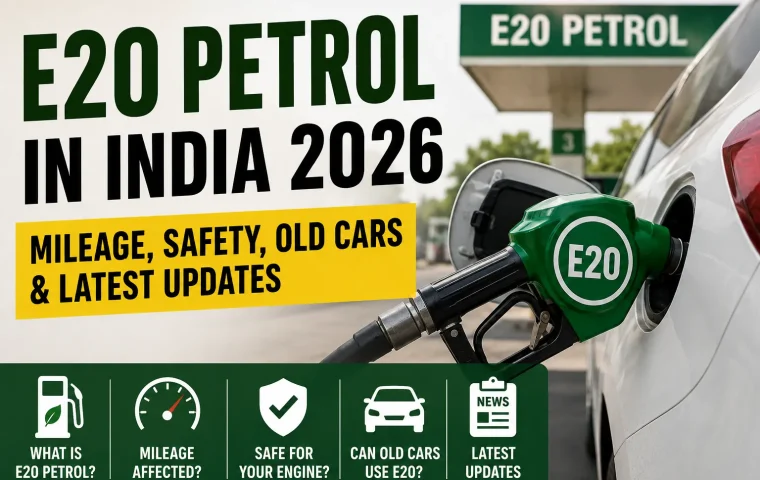
E20 Petrol in India is now a common topic among car and bike owners. Many people have questions about it. Will E20 petrol reduce mileage? Is it safe for the engine? Can old cars use E20 petrol? What is the difference between E10 and E20 petrol? And is E10 petrol coming back?
E20 petrol contains up to 20% ethanol mixed with petrol. India has been increasing ethanol blending in petrol for several years. The government says E20 fuel has been tested for engine performance, fuel-system parts, emissions, mileage and long-term use.
But vehicle owners still have genuine concerns, especially people who have older cars and bikes.
This guide explains E20 petrol in simple language. You will find information about mileage, engine safety, old cars, E10 vs E20, benefits, problems and the latest E20 news in India.
Quick answer: E20 petrol is meant to be used in vehicles that are approved for E20 fuel. Some vehicles can give slightly lower mileage because ethanol has less energy per litre than petrol. Older vehicles may need more attention, so checking the manufacturer’s advice is the safest option.
What Is E20 Petrol?
E20 petrol is petrol that contains up to 20% ethanol.
The letter “E” means ethanol, and “20” means the maximum ethanol content is 20%.
Here is a simple comparison:
| Petrol Type | Ethanol | Petrol |
| E0 | 0% | 100% |
| E5 | 5% | 95% |
| E10 | 10% | 90% |
| E20 | 20% | 80% |
For example, if you have 10 litres of E20 fuel, it can contain up to about 2 litres of ethanol and about 8 litres of petrol.
E20 is different from E85. E85 contains a much higher amount of ethanol and is used in special flex-fuel vehicles.
India started increasing ethanol blending in petrol many years ago. The country reached the E10 blending target in 2022 and then moved towards E20.
Why Is Ethanol Mixed With Petrol in India?
There are a few main reasons behind the E20 petrol programme.
India imports a large amount of crude oil. More ethanol blending can reduce the amount of petrol that needs to be made from imported crude oil.
Ethanol can also be produced in India from agricultural sources.
The government says the programme can help:
- Reduce crude oil imports
- Increase the use of Indian-made ethanol
- Support the ethanol industry
- Support farmers and agricultural activities
- Reduce lifecycle carbon emissions
The government estimates that E20 can reduce lifecycle carbon emissions by nearly 40%, depending on how the ethanol is produced.
E20 Petrol in India: What Is the Latest News?
The E20 issue has received a lot of attention in 2026.
The main questions are no longer only about ethanol blending. People are also asking about older cars, mileage and fuel quality.
The government has said that E20 was introduced after testing by organisations including the Automotive Research Association of India (ARAI), oil companies, automobile manufacturers and other technical institutions. The tests looked at areas such as engine durability, fuel-system parts, corrosion, emissions, starting and driving performance.
ARAI has also said that E20-compatible vehicles went through long-distance testing. According to its July 2026 clarification, testing covered around 40,000 to 60,000 km.
However, there are still concerns about fuel quality.
The government has been looking at stricter checks for chloride contamination in E20 petrol. Automobile companies had raised concerns about contamination in some fuel samples and its possible effect on vehicle parts.
There has also been discussion about making E10 petrol available again for some vehicles.
On August 28, 2026, BPCL’s chairman said the company was looking at an E10 option along with E20. The statement was later withdrawn. A government official also said there was no current plan to introduce E10 as a nationwide alternative.
So, if you see a headline saying “E10 petrol is coming back”, do not treat it as a confirmed decision yet.
Is E20 Petrol Safe for Cars and Bikes?
For vehicles that are designed and approved for E20, the government says the fuel is safe to use.
E20-compatible vehicles are tested for several things, including:
- Engine life
- Fuel-system parts
- Rubber and plastic parts
- Corrosion
- Starting
- Driving performance
- Emissions
- Fuel economy
ARAI has also reported testing of E20-compatible vehicles over long distances.
But there is one thing vehicle owners should remember.
Not every petrol vehicle is the same.
A new E20-compatible car and a 15-year-old petrol car may have different fuel-system parts.
That is why you should check the exact model and manufacturing year instead of assuming that every petrol vehicle will react in the same way.
Does E20 Petrol Reduce Mileage?
Yes, E20 can reduce mileage in some vehicles.
The reason is simple.
Ethanol contains less energy per litre than petrol. So, when more ethanol is mixed into petrol, the fuel can provide less energy for the same volume.
The government says some vehicles can see around 3% to 5% lower fuel economy. It also says mileage depends on other things such as driving style, traffic, tyre pressure, vehicle maintenance and AC use.
At the same time, ARAI has said that its testing of E20-compatible vehicles showed minimal fuel-efficiency impact under its test conditions.
So it would be wrong to say:
“Every car will lose 5% mileage with E20.”
That is not true.
The actual change depends on the vehicle and how it is driven.
Example
Suppose your car normally gives 18 km/l.
If its mileage falls by 4%, it would give around:
17.28 km/l
The difference is about 0.72 km per litre.
This is only an example. Your actual mileage may be different.
Why Can Your Mileage Change After Switching to E20?
If you see lower mileage, E20 may be one factor, but it is not the only possible reason.
Check these things first:
- Tyre pressure
- Air filter
- Spark plugs
- Engine condition
- Engine oil
- Traffic
- Driving speed
- AC usage
- Number of passengers
- Driving style
- Fuel quality
For example, a car that spends two hours every day in heavy traffic can give much lower mileage than the same car driven on an open highway.
So, checking mileage over one tank of fuel is not enough.
It is better to compare mileage over several tanks.
Does E20 Petrol Damage the Engine?
This is one of the biggest concerns among vehicle owners.
There are many posts online claiming that E20 petrol will damage or destroy older engines.
The available government information does not support such a broad claim.
The government has said there is no verified evidence of widespread engine failures or vehicle breakdowns caused by ethanol blending. It has also referred to testing and the use of ethanol-blended fuel in India.
ARAI has tested E20-compatible vehicles for engine durability and fuel-system compatibility.
However, this does not mean that every old vehicle is automatically safe.
Some older vehicles can have parts that were not designed for higher ethanol blends.
The government has said some older BS-III vehicles may need replacement of certain rubber parts and gaskets when using E20 fuel.
So there are two separate issues:
E20 compatibility and fuel quality.
A vehicle designed for E20 should be able to use fuel that meets the required standards.
But contaminated or poor-quality fuel can cause problems in any vehicle.
Can Old Cars Use E20 Petrol?
This is where many vehicle owners get confused.
There is no simple rule that says:
“Every car made before 2023 cannot use E20.”
The government has rejected this kind of broad claim. It has said E15-plus fuel has already been used widely and E19-E20 fuel has been in use for more than two years.
However, older vehicles may need more attention.
In July 2026, the government said some BS-III vehicles manufactured before 2016 may need replacement of certain rubber parts and gaskets while using E20.
This does not mean every old car needs the same repair.
The exact vehicle matters.
If you have an old petrol car
Follow these steps:
- Check the owner’s manual.
Look for the maximum ethanol blend allowed.
- Check the manufacturer’s website.
Search using your exact model and manufacturing year.
- Ask an authorised service centre.
This is useful if your manual does not clearly mention E20.
- Keep an eye on the car.
If you notice unusual starting problems, poor running or fuel-system issues, get the car checked.
Do not assume that every problem is caused by E20.
Can BS4 Cars Use E20 Petrol?
BS4 is an emission standard.
It does not automatically tell you whether a vehicle is E20-compatible.
So you should not assume that:
“All BS4 cars can use E20.”
You also should not assume:
“No BS4 car can use E20.”
Both statements are too general.
Check the exact model, engine and manufacturing year.
The manufacturer’s fuel recommendation is more useful than the BS4 label alone.
Can BS6 Cars Use E20 Petrol?
Many newer cars have been developed with higher ethanol blends in mind, and many E20-compatible vehicles are now available.
However, BS6 is still an emission standard. It is not the same thing as E20 certification.
If you own a BS6 car, check the owner’s manual or manufacturer’s official information.
Do not use the BS6 label alone as proof of E20 compatibility.
How to Check If Your Car Is E20 Compatible
Not sure about your car?
You can check it yourself in a few minutes.
Check your owner’s manual
Look at the fuel section.
Search for words such as:
- Ethanol
- E20
- E10
- Ethanol blend
- Fuel specification
Check the fuel-filler area
Some newer vehicles have fuel information near the fuel cap or fuel door.
Check the manufacturer’s website
Search for:
Car brand + model + year + E20 compatibility
Use the exact model instead of just searching for the brand.
Contact an authorised service centre
If you still cannot find the answer, give them your vehicle’s exact model, engine and manufacturing year.
That will give you a much better answer than a general online list.
E20 Compatible Cars in India
Many websites publish lists of E20-compatible cars.
These lists can be useful, but they can also become outdated quickly.
A car manufacturer can change an engine, fuel system or production specification without changing the basic model name.
For this reason, a better method is to check the manufacturer’s official information for your exact vehicle.
For example, saying:
“All cars from Brand X are E20-compatible”
is too broad.
A proper answer should mention the model, engine and production period.
If you are buying a new car, ask the dealer directly:
“Is this exact car E20-compatible?”
You can also ask them to show you the information in the vehicle documentation.
E10 vs E20 Petrol: What Is the Difference?
The main difference is the amount of ethanol.
| Feature | E10 Petrol | E20 Petrol |
| Ethanol | Up to 10% | Up to 20% |
| Petrol | About 90% | About 80% |
| Ethanol level | Lower | Higher |
| Energy per litre | Higher | Lower |
| Possible mileage impact | Lower | Higher |
| Current India policy direction | Earlier blend | E20 |
E20 contains twice as much ethanol as E10 at the maximum blend level.
Because ethanol has less energy per litre than petrol, E20 can affect fuel economy.
But this does not mean mileage will fall by 10% or 20%.
The vehicle’s engine and fuel system also matter.
E20 Petrol vs Normal Petrol
People often use the term “normal petrol” for petrol with a lower ethanol blend.
E20 is still petrol. The main difference is the amount of ethanol mixed into it.
Ethanol also has a high octane rating.
According to the government, ethanol has a Research Octane Number of about 108.5, while the blending process raises the effective octane level of Indian petrol to around 95.
But higher octane does not automatically mean better mileage.
Mileage depends on the engine and how the vehicle is used.
Benefits of E20 Petrol
E20 has several reasons behind its introduction.
1. It can reduce crude oil imports
India imports a large amount of crude oil. Using ethanol produced in India can reduce some of the petrol requirement linked to imported crude.
2. It supports ethanol production in India
Higher ethanol blending creates more demand for ethanol.
3. It supports agricultural activities
Ethanol can be produced from several agricultural feedstocks.
4. It can reduce lifecycle emissions
The government says E20 can reduce lifecycle carbon emissions by nearly 40%, depending on the production process.
5. Ethanol has a high octane rating
This can help improve anti-knock performance in engines designed for the fuel.
Disadvantages of E20 Petrol
E20 also has some concerns.
Mileage can be lower
Some vehicles may give lower fuel economy because ethanol contains less energy per litre.
Older vehicles may need attention
Some older vehicles may have fuel-system parts that need inspection or replacement.
Fuel quality is important
Recent concerns about chloride contamination show why fuel quality needs proper checks.
Consumers are confused
Many people still do not know whether their particular car or bike is E20-compatible.
Real-world results can differ
Two people can use the same fuel but get different mileage because their vehicles and driving conditions are different.
E20 Petrol Myths vs Facts
There are many claims about E20 petrol on social media. Here are some of the common ones.
| Claim | Fact |
| E20 means 20% lower mileage | No. E20 refers to the ethanol blend, not a 20% mileage loss. |
| E20 will destroy every old car | There is no evidence to support this broad claim. Some older vehicles may need specific parts checked. |
| Every car made before 2023 is unsafe with E20 | The government has rejected this broad claim. |
| E20 has never been tested | False. E20-compatible vehicles have undergone extensive testing. |
| E20 cannot affect mileage | Also false. Some vehicles can see lower fuel economy. |
| Every engine problem after E20 is caused by ethanol | Not necessarily. The vehicle needs proper diagnosis. |
| BS4 automatically means E20 compatible | No. BS4 is an emission standard, not an E20 compatibility label. |
| BS6 automatically means E20 compatible | BS6 alone does not prove fuel compatibility. Check the vehicle’s specification. |
What Should You Do If Your Car’s Mileage Has Dropped?
If your mileage has fallen, don’t immediately blame E20.
Start with the basics.
Check tyre pressure
Low tyre pressure can reduce mileage.
Check the air filter
A dirty air filter can affect engine performance.
Check spark plugs
Worn spark plugs can also affect fuel economy in petrol engines.
Check your driving
Hard acceleration and frequent braking can reduce mileage.
Check the AC
Heavy AC use can increase fuel consumption.
Compare several fuel tanks
Do not judge mileage from one tank alone.
Check the fuel quality
If your vehicle starts behaving differently soon after refuelling, keep the fuel receipt and get the vehicle checked.
What Should Owners of Old Cars Do?
If you own an older petrol car, you do not need to panic.
First, find out what your manufacturer says.
If the vehicle is E20-compatible, follow the manufacturer’s instructions.
If compatibility is unclear, ask an authorised service centre.
If your vehicle is an older BS-III model, ask whether any rubber parts, gaskets or other fuel-system parts need inspection. Government information has specifically mentioned possible replacement of some parts in older vehicles.
Most importantly, don’t replace parts just because you read a random post online.
Get the vehicle checked first.
Is E10 Petrol Coming Back in India?
This question became important again in August 2026.
On August 28, BPCL’s chairman said the company was considering an E10 petrol option along with E20. The statement was later withdrawn.
A government official also said there was no plan to introduce E10 as a nationwide alternative at present.
So the situation is clear for now:
There is no confirmed nationwide decision to bring E10 petrol back as a standard alternative to E20 as of August 28, 2026.
This can change in the future, so this part of the article should be updated if the government announces a new policy.
Why Is Fuel Quality Important With E20?
The discussion around E20 is not only about the percentage of ethanol.
The quality of the fuel also matters.
Recent reports have highlighted concerns about chloride contamination in some E20 fuel samples. The government has been looking at stricter enforcement of the existing limit for chloride in E20 petrol.
This is why it is useful to separate two things:
E20 compatibility means whether your vehicle is designed to use the fuel.
Fuel quality means whether the petrol meets the required standards.
A vehicle can be designed for E20, but that does not mean contaminated fuel is acceptable.
Is E20 Petrol Good or Bad?
There is no single answer that fits everyone.
For India, E20 can help reduce dependence on imported crude oil and increase the use of ethanol made in the country.
For a vehicle owner, the main questions are different.
You want to know:
- Will my car give the same mileage?
- Is my engine safe?
- Can my old car use E20?
- Does my manufacturer allow E20?
- Will my maintenance cost increase?
- Is the fuel quality good?
For a vehicle that is approved for E20, current government and ARAI information does not show widespread engine damage from normal E20 use.
For an older vehicle with unclear compatibility, checking with the manufacturer is the better choice.
E20 Petrol: What Should You Do?
Here is the simplest way to decide.
| Your situation | What you should do |
| New E20-compatible car | Use E20 as recommended by the manufacturer |
| New bike approved for E20 | Use E20 according to the manufacturer’s instructions |
| Older petrol car | Check the owner’s manual and manufacturer |
| Pre-2016 BS-III vehicle | Ask a service centre about fuel-system parts |
| Mileage has fallen | Check the vehicle and compare mileage over several tanks |
| Engine problem after refuelling | Get the vehicle inspected |
| You saw a social-media claim | Check the original government/manufacturer source |
Frequently Asked Questions About E20 Petrol in India
What is E20 petrol?
E20 petrol is petrol containing up to 20% ethanol.
Is E20 petrol safe?
It is intended for vehicles that are designed and approved for E20. Government and ARAI testing has covered engine durability, fuel-system compatibility and other areas.
Does E20 petrol reduce mileage?
It can reduce fuel economy in some vehicles. The government says some vehicles can see around 3–5% lower fuel economy.
Does E20 petrol damage the engine?
There is no verified evidence of widespread engine failure caused by E20, according to the government’s current assessment. However, some older vehicles may need specific components checked.
Can old cars use E20 petrol?
It depends on the vehicle. Some older vehicles may need attention to certain fuel-system parts. Check the manufacturer’s recommendation.
Can BS4 cars use E20 petrol?
BS4 alone does not tell you whether a car is E20-compatible. Check the exact vehicle specification.
Can BS6 cars use E20 petrol?
Many newer vehicles are E20-compatible, but BS6 alone is not proof of E20 compatibility.
What is the difference between E10 and E20?
E10 contains up to 10% ethanol, while E20 contains up to 20% ethanol.
Does E20 mean 20% less mileage?
No. The 20% refers to the maximum ethanol content in the fuel. It does not mean mileage will fall by 20%.
Why is ethanol added to petrol?
The main reasons include reducing crude oil imports, increasing domestic ethanol use and reducing lifecycle emissions.
Is E10 petrol coming back in India?
As of August 28, 2026, there is no confirmed nationwide decision to bring E10 back as a standard alternative to E20.
How can I check if my car is E20-compatible?
Check the owner’s manual, fuel-filler information, manufacturer’s website or ask an authorised service centre.
Final Verdict on E20 Petrol in India
E20 petrol is now an important part of India’s fuel system, and vehicle owners will continue to have questions about it.
The biggest mistake is to believe either extreme.
It is not correct to say that E20 will destroy every petrol car.
It is also not correct to say that E20 has zero effect on every vehicle.
The reality depends on the vehicle.
A newer E20-compatible vehicle is designed and tested for the fuel. Some vehicles may see a small change in mileage. Older vehicles can have different fuel-system requirements, and some may need specific parts checked.
Fuel quality also matters.
If you own a car or bike, the best thing you can do is simple: check your exact vehicle’s E20 compatibility instead of relying on general claims.
Check the owner’s manual. Check the manufacturer’s information. Ask an authorised service centre if you are unsure.
And if your mileage changes, compare it over several fuel tanks before reaching a conclusion.
E20 petrol is likely to remain a major part of India’s fuel policy, so the discussion around mileage, older vehicles, fuel quality and E10 availability will continue.
Last updated: August 28, 2026

Leave a Reply
You must be logged in to post a comment.