
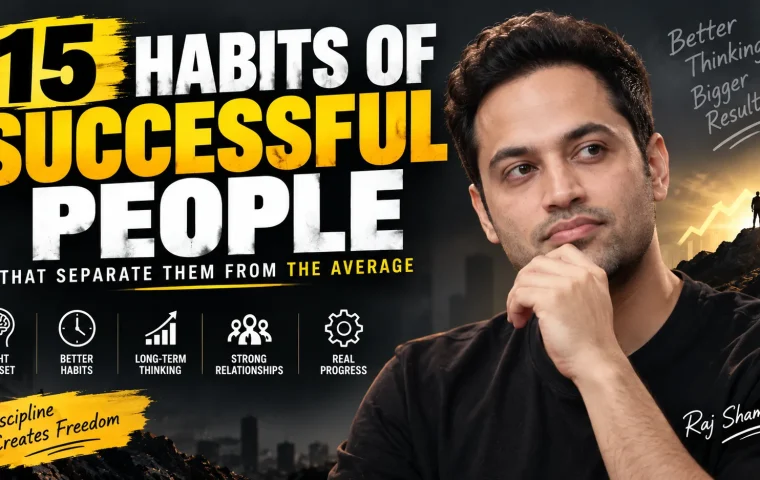
15 Success Habits and Mentalities of Successful People versus Average People
People think that money, fame, a good career, high position is success. However, a closer examination of those who still are successful over many years even reveals that they are able to do that because of something deeper. Their actions, thinking style, associates and problem-solving approach is very significant.
Successful people’s habits are not necessarily spectacular to the outsider. Most of them are quite basic. They judge not which they do not learn. They consider long-term results in their thinking. They value and defend their time. They continually develop their techniques. They earn the trust, not the attention.
These habits also are the reason why two people who both possess the same talent may achieve very different outcomes.
A recent podcast discussion touched on this in many different ways: fear, ambitions, long-term thinking, respect, trust, wealth, AI, knowledge, and resourcefulness. Successful people are often more interested in the how instead of the what was the outcome was one of the strongest ideas that came from the discussion.
So, what are the behaviours and attitudes that produce this difference?
Let’s look at 15 of them in detail.
1. Successful People Try to Understand Things, Not Just Get Results

One of the biggest differences in the mindset of successful people is their interest in understanding the process.
The typical mediocre approach will be something like this:
I want the answer, tell me what to do.”
A better solution is:
I want the answer and want to know why it works.
It is a significant disparity over the years.
Let’s say there are two individuals who would like to have a successful YouTube channel. First player seeks formula. They create popular thumbnails, take video topics, look closely at the trending formats and hope for the numbers to grow.
The second person researches the reason for the difference in performance of videos. They are observing the subject, title, the preview/thumbnail, the audience engagement, the introduction, cutting and editing, sharing, and audience response. They experiment with various concepts and draw conclusions on the basis of their experiments.
The second person isn’t only out to make a successful video. They’re seeking to get to to a degree the system of what is actually working together with video clips.
That knowledge is put to use time and time again.
Similarly, whether we’re talking about business, marketing, technology, investing, sales, careers, or nearly any other area, that is the case.
So one of the most effective (and successful) people habits has to do with learning how things work and not simply learning what to do.
That is what the podcast conversation says about those “who are ‘greedy to understand the world’”. The premise is that the comprehension of a valuable process can be where the money or status is found rather than what is being sought.
2. They Transcend Fear to Curiosity
The problem with fear is it can prevent someone from taking action. But, it also can be a learning opportunity.
It’s about what you do with it.
If you fear AI will impact your job, You can gripe about it for months or you can learn how AI is transforming your industry.
The second answer was to transform fear to curiosity.
That doesn’t mean that successful people don’t experience fear. They do. Many of them fear and are fearful, often, one of the reasons they keep learning.
One of the reasons given in the podcast to continue upskilling to understand new technologies, younger generations and changing societal patterns is the fear of becoming irrelevant.
This is a helpful attitude for those who are developing their careers.
Instead of saying:
“AI is going to take my job.”
Try asking:
How much work can be automated using AI? Where do the remaining subjective decisions need to be made? What skills will be more in demand? “What is the best way to utilize these tools than others?”
The first is to inflict terror.
The second is the development of a learning plan.
Curiosity is a way of activity with doubt.
3. They operate on the principle of time, not days.
Short term is appealing because it’s instant gratification.
You are paying money and then you will receive something right away.
You don’t go to work and you have a nice evening.
That is when you stop learning – due to fatigue.
An easy task instead of a difficult one is one you select.
The issue is that there are a lot of important results that don’t come off of that kind of process.
Skills take time. Trust takes time. Reputation takes time. Development of physical fitness is a time consuming process. A successful career doesn’t just happen overnight. When the business is successful, it would have taken many years.
Skills, reputation, trust, wisdom, wealth and health are assets that increase in value with thinking over the long term, the podcast stated.
Consider acquiring a trade.
You might feel that you aren’t getting much back for the first few months. You are learning some and getting some things wrong, following instructs, and completing simple things.
Then something changes.
One year later, you know what you’re doing.
On completion of three years, you can tackle tougher problems.
In 5 years, others might turn to you for assistance.
It didn’t happen out of the blue. It built slowly.
This is what makes thinking long term, one of the top success traits.
They have been asking themselves a different question than “Is it going to make me happy now?” They’re asking, “Will it support me five years into the future?”
4. They Guard their Time and Attention
A day is 24 hours long for everyone.
It’s just the use people make of those hours.
One of your most scarce resources is your attention. As soon as you spend an hour watching little videos, an hour is gone. It cannot be postponed till tomorrow.
However, this is not to say entertainment is bad. Rest matters. The problem begins when entertainment takes the place of time you should have spent learning, working, staying healthy, being with the people you love, or creating something of value.
But that’s not so easy with social media all around, since it’s designed to grab attention.
Open an app for 5 minutes and you can find yourself spending an hour there.
The successful are not necessarily better time managers than others because they have some secret system of productivity that makes them more productive. Often they just start being more careful as to who catches their attention.
They understand that there is a price for each “yes”.
Three hours of watching random content equals three hours LESS available to practice a useful skill.
The gap will not be that great over a day.
It can grow to be gigantic in over five years.
5. They select their setting carefully:
You’re environment dictates your sense of what is normal.
These methods can be adopted by you to make things look good when everyone around you does the same.You can adopt them to feel good if everyone else around you does the same.
Your associates may become negative about work if they never attempt to learn anything new either.
Behavior can normalize when those around you are building businesses, learning hard topics or exercising, reading, creating ideas and discussing.
Here’s one reason why social circles are important.
The podcast touched upon others exercising a strong influence in the lives of others, and how social media can help or hinder individuals even if they are looking for positive change.
Your future isn’t up to your surroundings. But it can make some decisions a lot easier, and some a whole lot harder.
This doesn’t mean that you need to sever all ties to others.
Just have to be aware who the people are that influence your thoughts.
Consider what you normally discuss with close friends and family.
Does it involve conversations about ideas, work, health, skills, business, books, technology and plans?
Then, is the majority of discussion regarding other people, grievances, amusement, or fleeting crises?
Roye’s methodically edits its surroundings so you can read clearly what you need to value.
6. They would rather be respected than liked.
It’s good to be liked.
A post gets likes. A healthy joke is given respect. People compliment you. Your audience grows.
Size isn’t everything, however!
It is possible to be popular in no time. Respect typically takes a lot longer.
One person can make a hilarious video and earn millions of views! Does not mean that they are judged to be respected in terms of ability, judgment or character.
Respect is a product of action over time.
You show up.
You do good work.
You are true to your word.
You get better at doing it.
You are good at handling challenging situations.
Individuals recognize a pattern.
Respect as stated in the podcast is a part of consistency, and longer-term behaviour. It also stated, “One can admire someone one minute without being able to respect them in the longer term.
This is a significant lesson to be learned in personal branding as well.
Never make the whole purpose of your life, ‘getting attention’.
Develop a good reputation for something.
Focus can get lost easily.
Respect can last a lifetime.
7. They know the importance of trust.
Building Trust is hard and losing it is easy.
When someone knows you are private with your confidential information, timely and that you tend to tell the truth and own up to your errors, they are more apt to trust you with greater responsibility.
This trust can bring opportunities.
You might be assigned an important project by a manager.
You can be transferred to a bigger account.
A business partner can pass along to you the necessary information.
An investor might be more inclined to accept your proposal.
The possibility that a colleague will recommend you to work for another job.
The podcast talked about how important it is to keep someone’s information private as a confidence and to equate this to trusting someone to hold something of value.
Being a good person is not the only part of trust. It is also of practical value.
The highly skilled yet untrustworthy: can be a problem to work with.
Those who are skillful and dependable can be invaluable.
That’s why you should consider trust as part of your professional reputation.
8. They look for patterns;
Good people’s picking up of patterns is an effective trait in success.
They don’t necessarily settle for the first answer they get.
“They return to see the same action over and over again”.
So there are 10 marketing campaigns you are running.
A campaign works well.
That isn’t saying much.
However, if a message, audience, offer, or creative continues to work well, then across numerous campaigns you might have a pattern.
The next time is to test it once again.
There is a simple example provided in the podcast of how to repeatedly test predictions to identify who is consistently performing well. One successfully achieved idea was not the important idea. The recurring motif was it.
It’s a good attitude to have in all situations.
A salesperson knows what kinds of dialogue to read that result in sales.
A developer will be able to observe their problem areas.
A marketer can learn which messages are successful with his or her audience.
A manager can learn about what nations, streets or even teams always do things better.
The more pattern examples collected by comparing, developing an idea and testing, the stronger pattern recognition is.
It’s not a game of “Sorry, wasn’t at school today”.
It’s about learning from the evidence and evidence again.
9. They relentlessly strive to further develop their work.
Often times, “good enough” is bad work.
Successful folks rarely take a thing for granted just because it does.
They ask:
“What is not good enough and how can it be made better?
That is a recursive question!
You build something.
You release it.
You watch and see how it goes.
You find problems.
You fix them.
You test again.
Then you repeat the process.
The podcast stated that a person was like an app. Features and bugs are typical traits of an application and each ought to be improved frequently.
The same thought holds true with work.
You have strengths and weaknesses in your skills.
There are good and less good aspects to your communication style.
You have strong and weak areas in the way you work.
You have good and bad parts about your decision making process.
There’s no need to do everything in one go.
It is important to continually seek the next thing that could be better.
There’s also research to suggest the importance of practice, as well as the idea that practice alone is not the key to success. A large meta-analysis showed that deliberate practice was associated with performance (positive relationship); however, the magnitude of the relationship varied substantially per field.
The simple message here is: practice is important, but quality, type of practice is important as well.
10. If you aren’t at ease in a place of discomfort, you might be focused on the wrong thing.
Growth seldom feels good.
Learning something difficult can make you feel stupid.
Entrepreneurs’ doubts can set in when they first start their business.
Pressure can be created when taking responsibility.
Addressing an audience can be a daunting experience.
Failure is a potential result of trying something new!
There are many people who don’t have experiences of these because they do not want to feel like they should do something before they feel confident.
Effective individuals can work differently.
They know that confidence is gained through repeated actions over time.
For instance, for a person who would like to become a better public speaker, he can’t just think his way to confidence. They must be required to make presentations before others and must be allowed to make mistakes, know why they went wrong, and make another presentation.
This also goes for technical abilities.
Don’t think you’re going to become good at cyber security just by watching cyber security YouTube videos.
You’ll be expected to deal with systems, be wrong, explore issues and correct issues.
Useful discomfort does NOT equal suffering without purpose.
It involves spending time on hard things, to make you better.
11. They Do Their Best to Become Irreplaceable
The value of labor is good, but it isn’t a prescription for high wages.
The true question is:
What problem does my work address?
One of the main points during the podcast on wealth was that it is this. You can be doing an extremely hard problem over which almost nobody cares, and just get less than a person who is doing one of the high value problems.
Consider two workers.
One man working 8 hours on a task that can be done by hundreds of men.
A problem is solved by another in four hours, which saves millions of rupees to a company.
Even though the latter may be working less, he or she can contribute much more economic value.
This not necessarily indicates that everyone ought to pursue cash.
It implies that you need to realise the worth of your ability.
Ask yourself:
What type of problems can I solve?
How difficult are those problems?
How many can solve them?
How significant are those problems?
How much better can I become?
This is one of the most powerful routines of the successful individuals in the world, because instead of spending your time and energy in effort, you’re focusing on value.
12. They apply Artificial Intelligence to enhance their thinking.
Human beings are changing their way of work due to AI.
However, relying on AI effectively isn’t the same as expecting it to do everything for you.
A great way to do this is to rely on AI as a second pair of minds.
You can prompt it to question a concept.
You can request it to determine the weaknesses of a plan.
It can be used to help understand a complex concept from a different perspective.
Comparisons of solutions can be made.
You can’t just take action, though.
This becomes increasingly more significant as AI tools become more capable.
Equal access to the same tools can mean that AI alone doesn’t result in a sustainable advantage.
This edge can be as a result of asking the proper questions, comprehending the issue, verifying the solution and finalizing the choice.
The podcast spoke of using AI to make the very capable professional more efficient than attempting to replace each individual in a profession.
For instance, a skilled software developer with expertise in effective AI application could construct and test considerably more rapidly.
An excellent marketer can utilize AI to brainstorm concepts, evaluate consumer reviews, generate variations, and streamline repetitive tasks.
However, there must be judgment on the part of the person.
AI has the capability of generating an answer.
You must determine if it’s a good answer.
13. They are interested in valuable problems.
Being busy is not important problem solving.
Entities in the email, meetings, notifications and perform tasks and do it all day long.
Productive feeling at end of day.
So what is it you changed?
In fact, successful people tend to be more adept at the ability of problem recognition, as it is an important problem for them.
The business owner could see that customers are having difficulties with a slow process.
A software developer may find that a team is wasting hours by performing manually.
One of the things a marketer may find is that a company is spending money on advertising without knowing which clients are good clients.
You don’t hear a good prosciutto ask, “What should I do?
They ask as well, “What is the issue I must tackle or address?”
This shift of mindset can positively affect your career trajectory.
The problems you can fix are often correlated with the value of your salary, your business or even your professional value.
14. They Do Things Rather than Wait for Motivation
Motivation is unreliable.
On some days you’re excited.
Other days nothing goes as you don’t want to work at all.
Your progress is entirely subject to motivation – and how you feel today, if that depends solely on your motivation levels.
Successful individuals create systems and habits that enable them to continue to thrive even when they aren’t feeling excited.
A writer writes.
A developer codes.
A telephone call from one salesperson to another.
A student studies.
A business owner looks at some figures.
You don’t have to be on the inspirational roller-coaster each morning.
Action creates feedback.
Feedback creates learning.
Learning creates improvement.
That is also the reason one ends up having such challenges identifying ambition from a person’s sayings.
Getting to the key point in the podcast, the truly ambitious might not talk a lot about their ambition to be truly ambitious. It is evident in their work. They create, test, refine, and persevere.
It’s not necessary to hit everyone asking to talk about your illness.
You can tell in your work.
15. They do more than just talk about it, they build instead.
Looking successful and becoming successful are two different things.
This difference is obscured with social media.
People can delude themselves that they are making progress and yet not get very far.
They can write about their plans.
They can post images with motivational quotes.
Each could month, they get to declare a new project.
They can speak as entrepreneurs, creators, investors, leaders or experts.
Labels are not responsible for ability!
Work does.
It was noted on the podcast that sometimes people aren’t as ambitious as they think they are, but you can tell by what they are creating and not just the name that they put on themselves.
Suppose there are 2 individuals who wish to venture into business.
Person A gives 6 months’ worth of discussion of the idea.
After six months person B is talking with customers, creating a rudimentary product, listening to their reactions, fixing things and attempting them once again.
Even if it doesn’t work out for Person B on his/her first try, he/she has something worthwhile to know.
That’s solid progress.
Building provides you with information that talking alone can’t provide you.
The Most Effective Habits of Successful People are the ones that are Developed Over the Years.
This is not a list of 15 habits that you will strive to complete in one month.
Disciplined, patient, curious, more highly respected, more skillful – by no means do you become those things in one instant.
These qualities are formed as a result of repeating actions.
Work on one area first.
If you’re thinking short-term, begin to think long term.
When distracted all the time, guard the attention point!
When you’re afraid of something new, learn about it!
Walk the fine line of not giving a second thought to being liked; let work be your primary focus.
If you are making a tremendous effort but have yet to achieve career advancement, then you should examine the importance of the problems you are solving.
Don’t continue consuming if you aren’t building; begin to create.
Little changes count when they occur over the course of several years.
No Two People Can Do the Same Way and Still Be Successful”.
In the interest of succeeding, another important point is overlooked.
Not everyone that is successful gets up at 5 AM.
Not everyone of them meditates.
Not everyone reads every book in the year!
Not all of them have the same morning routine.
There isn’t specific day-to-day regimen that works all the time.
The deeper the habits—the better.
They learn.
They think.
They test ideas.
They work with their focus.
They develop trustful relationships.
They enhance their skills.
They have a knowledge of the world around them.
They are used to solve a useful problem.
They consider themselves for the long haul.
There are a lot of lifestyles that can enjoy of those habits.
These basic habits can differ between a software engineer, doctor, entrepreneur, teacher, designer, athlete, and marketer, all of which may have vastly different schedules.
It is not enough if students have to work hard.
Hard work should not be considered outside of the value, and this is one of the most important lessons from the podcast.
There are millions of people who are hard at work.
However, that which is good for some as a result in hard work doesn’t work out for other individuals.
Why? Effort by itself isn’t enough for the market. It also incentivises the value which is created from that effort.
An individual can work 12 hours on something that is not difficult to replace.
Someone else might be employing five hours to discover a solution to an intricate problem that not many individuals know how to solve.
The second person’s work could be worth so much more.
This is where developing valuable Skills are a factor.
You may lose bargaining power if your work becomes easier to replace.
You can become a part of few people who can solve an important problem well and thus your value can also increase.
More hours is NOT the objective.
This should be focused on problem solving at higher levels of complexity.
Status can be less important than Knowledge.
Fame is powerful, as it’s apparent.
Money is so appealing because it gives access.
It is popular, which means that it is seen by many.
But, knowledge is not the same way.
Information and facts can support an individual to make better choices.
Can be useful in comprehending individuals.
It can help you to see opportunities.
It may save you a ton of costly blunders.
Can make you learn new fields quicker.
The podcast conversation clearly distinguished fame, wealth, respect and knowledge and how chasing knowledge could be an outcome of respect.
Money and star power are not of no redemption, this mean only that.
They can afford access and opportunity.
But they don’t equate with ability.
Money lose can be recovered if you are able to create values again, knowing that you have the skills and knowledge.
For this reason, the ideal long term investment is a self development investment rather than a look successful investment.
If you are resourceful, that’s a major success skill you are showing off!
One quality that should be singled out and given special consideration: “Resourcefulness.
When a plan fails, a resourceful person doesn’t give up.
They seek an alternate means.
They locate a person who can aid.
They acquire the lack of skill.
They take another tack.
They make the best of what they have.
They’re concerned about the results rather than getting bogged down by the hurdle.
This is not to be confused with the word intelligent.
But even with a sound grasp and understanding of a problem, one may not be able to solve it.
What a resourceful individual might not know, he or she knows how to go forward.
For instance, you have an assignment to do, but you don’t know how to work one of the tools you have to use.
One response is:
“This is a tool I don’t know how to use so I can’t do it.”
One is a resourceful:
“This is a new tool to me. “What is the lesson I must learn or who can help me to solve this?”
The latter is a very important mindset to have in business and in a career.
The Podcast also addressed the distinction between those that can understand, and those that can make things happen.
Emphasize skill areas that compound!
Certain skills are enhanced through long-term use.
Information sharing is an example.
The more you communicate, the more selling your idea, leading your team, negotiating, delivering a lesson, and creating a relationship will be easy.
The same role can be played by technical knowledge.
The better acquainted you are with a subject area, the better you will comprehend the advanced issues.
Your reputation may multiply as well.
By consistently performing good, reliable work, people begin to trust you for more responsibility.
This is where the long-term is most important.
You’re not just working for today.
You are creating wealth for tomorrow!
Skills.
Knowledge.
Trust.
Reputation.
Relationships.
Health.
Although these may not be rewarding at the moment they may be worth something as time goes on.
The Different Mindset Of a Successful Person From An Average Thinking One.
First and foremost, intelligent is not usually the biggest difference.
It’s the attitude with respect to time, learning, problems, and responsibility.
An average mind will say:
How do you want to get the result FAST?
A better mindset thinks,
How does it work?
The average mind will say:
“What is the secret to not failing?”
A more powerful mind presents itself with questions, like this:
“What are the lessons I can draw from this?”
An average mentality might ask itself:
How to make people like me?
The stronger mindset is asking:
“How can I become respectable?”
The average person’s mind may question:
So, how many hours did I work?”
An improved mindset inquires:
My work solved a valuable problem by answering the question, “What is it?”
An average mindset will ask:
“What should I do?”
A more powerful mindset will pose the questions:
“What should I get?”
It can totally transform your attitude toward your career and life.
Final Thoughts
Successful people don’t have a system or the perfect morning routine.
They’re related to what you do over and over again.
True people of achievement learn to think “outside the box”. They guard their notice. They carefully select their surroundings. They build trust. They seek for relationships. They keep improving. They adopt new technology but retain their own critical thinking. They’re looking at good issues and get to be useful at handling things.
Most importantly, they build, don’t just talk.
Being successful also doesn’t mean that a person never fails. If you’re making something worth having, there are going to be some failures, there are going to be some uncertainties, and there are going to be some tough times.
It’s what goes beyond those seconds that counts.
Do you learn?
Do you adjust?
Do you try again?
Are you improved?
Those who continue to do so, year after year, are often quite different from those who continue to seek fast results looking for quick fixes.
There’s no need to duplicate anyone’s lifestyle.
Think first.
Understand rather than only seeking results. Schedule in years, not days! Become curious, don’t be afraid. Protect your attention. Build useful skills. Earn trust. Solve valuable problems. Keep improving.
Those little choices can turn into behaviors that characterize your profession, fame and success over time.


Leave a Reply
You must be logged in to post a comment.