
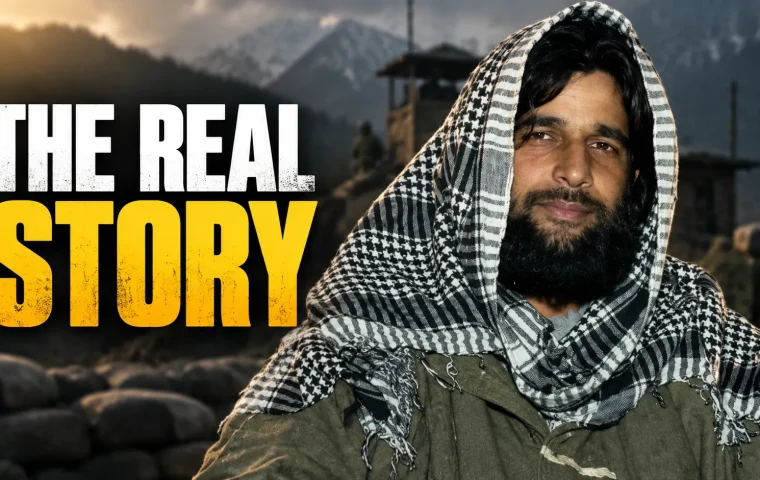
Major Mohit Sharma: The Real Story of Iftikhar Bhatt
Major Mohit Sharma was an Indian Army officer from 1 Para Special Forces who became known for his undercover work and his final operation in Kupwara. In 2004, he reportedly entered a Hizbul Mujahideen group under the identity Iftikhar Bhatt. Five years later, he was killed during an operation in North Kashmir after rescuing wounded soldiers and fighting militants despite being seriously injured. He was posthumously awarded the Ashoka Chakra.
His story has received renewed attention because of public discussion around the film Dhurandhar. However, the film’s director has denied that the movie is based on Major Mohit Sharma’s life.
Major Mohit Sharma: Quick facts
| Detail | Information |
| Name | Major Mohit Sharma |
| Birth | 13 January 1978, Rohtak, Haryana |
| NDA | Joined in 1995 |
| Commissioned | December 1999 |
| First regiment | 5 Madras |
| Kashmir posting | 38 Rashtriya Rifles |
| Special Forces | 1 Para SF |
| Undercover identity | Iftikhar Bhatt |
| Undercover operation | 2004 |
| Final operation | 21 March 2009 |
| Location | Kupwara, North Kashmir |
| Gallantry awards | Sena Medal, Ashoka Chakra |
| Death | 21 March 2009 |
Public sources agree on his military career, Special Forces service, 2004 undercover mission and 2009 action. Some detailed accounts of the undercover operation come from secondary reporting rather than the official Ashoka Chakra citation, so those details should be treated accordingly.
How we evaluated the story
This article separates documented military records from later accounts.
The main criteria were:
- Official government records for the 2009 operation and Ashoka Chakra citation.
- Reporting from established Indian news organisations for his career and 2004 undercover mission.
- Cross-checking dates, military units and awards across sources.
- Separating reported details from information confirmed in official records.
- Avoiding claims that could not be supported by the available research.
The official Gazette is the strongest source for what happened during his final operation. It records that Major Sharma was leading the Bravo Assault Team in Kupwara on 21 March 2009, rescued two wounded soldiers, killed two terrorists with grenades, was shot in the chest, continued directing his men and then killed two more terrorists in close combat.
Early life and decision to join the Army
Major Mohit Sharma was born in Rohtak, Haryana, in 1978. He joined the National Defence Academy in 1995 and later completed his training at the Indian Military Academy. He was commissioned into the 5th Battalion of the Madras Regiment in December 1999.
His route into the Army was not completely straightforward. Reports say he had initially entered engineering but chose to leave that path because he wanted to serve in the Armed Forces.
After his commissioning, Sharma served in counter-insurgency operations in Kashmir. He was posted with 38 Rashtriya Rifles and received a Chief of Army Staff Commendation Card in 2002, according to published accounts of his career.
From 5 Madras to 1 Para Special Forces
Sharma later volunteered for the Para Special Forces and joined 1 Para. His work increasingly involved operations against militant groups in Jammu and Kashmir.
The Special Forces role also put him in situations where conventional military methods were not always enough. In counter-insurgency operations, understanding local conditions and gathering information could be as important as direct combat.
His 2004 undercover mission became one of the most discussed parts of his military career.
Major Mohit Sharma and the Iftikhar Bhatt undercover mission
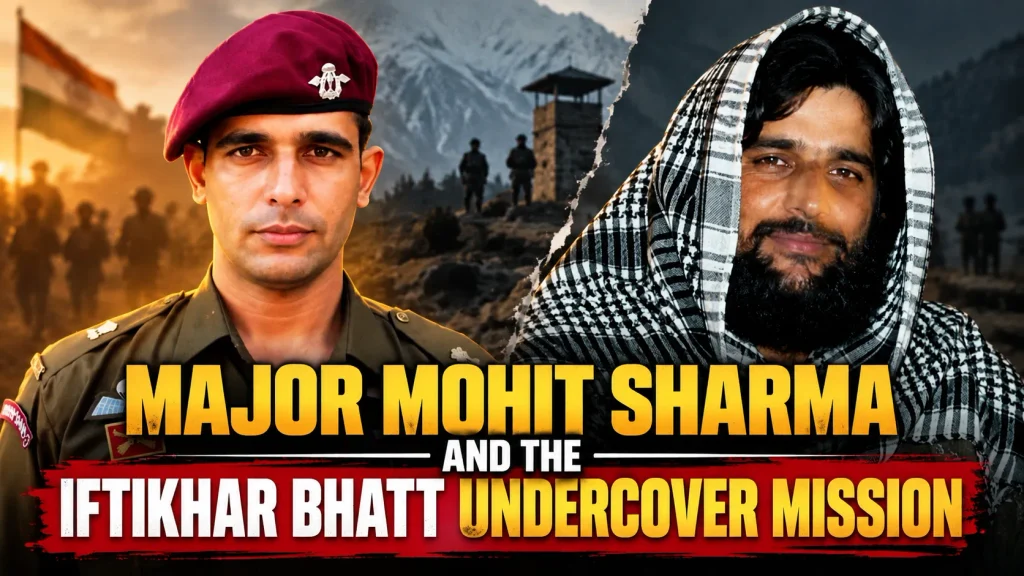
In 2004, Major Mohit Sharma reportedly infiltrated a Hizbul Mujahideen group while operating under the identity Iftikhar Bhatt.
According to published accounts, Sharma adopted the appearance and manner of a local Kashmiri and presented himself as someone who had developed hostility towards the Indian Army. His cover story included a claim that his brother had been killed by security forces. The purpose was to convince militants that he wanted to join them.
The account says Sharma gradually gained the confidence of members of the group. He was eventually able to gather information from inside the organisation and acted against two senior militants.
This part of his career is often described as an example of undercover counter-insurgency work. It is also the section where online retellings contain the most dramatic details.
What is confirmed about the Iftikhar Bhatt operation?
Established reporting supports the broad outline: Sharma operated undercover in 2004 using the name Iftikhar Bhatt, infiltrated a Hizbul Mujahideen group and killed two militants. Reports also connect the operation with his Sena Medal.
Some widely repeated versions add details about conversations, weapons, a particular hideout encounter and the exact sequence in which the two militants were killed. Those details are not contained in the official Ashoka Chakra citation, which deals with his 2009 action.
For that reason, those parts should be presented as reported accounts rather than established facts.
Why was the Iftikhar Bhatt mission so difficult?
The danger came from the need to maintain a false identity while operating inside an armed militant network.
A mistake could expose the officer before useful information was obtained. His cover also had to remain believable to people who were familiar with the area, local speech and the activities of security forces.
Reports say Sharma used his understanding of the local environment and his ability to communicate in the region to maintain the identity.
The mission eventually resulted in action against two militants and became one of the reasons Sharma received the Sena Medal.
Major Mohit Sharma’s final operation in Kupwara
The most firmly documented part of Major Mohit Sharma’s story is his final operation in March 2009.
On 21 March, he was leading the Bravo Assault Team during an operation in Kupwara District of North Kashmir. The Army had information about infiltrating terrorists in a dense forest area. Sharma planned the movement and led his commandos while they tracked the group.
The team came under fire from three directions.
Four commandos were wounded during the initial exchange.
Instead of pulling back, Sharma moved forward under fire and recovered two wounded soldiers. He then used grenades against the militants and killed two of them.
During the action, Sharma was shot in the chest.
The official citation records that he continued directing his commandos despite the injury. When he saw further danger to his men, he moved into close-quarter combat and killed two more terrorists.
He died during the operation.
This account is important because it comes directly from the Government of India’s published gallantry citation rather than from later retellings.
Why did Major Mohit Sharma receive the Ashoka Chakra?
Major Mohit Sharma received the Ashoka Chakra posthumously for his actions during the March 2009 operation in Kupwara.
The official citation describes his leadership under fire, his rescue of wounded soldiers, the killing of four terrorists and his decision to continue fighting after being shot in the chest. The award was effective from 21 March 2009.
The Ashoka Chakra is India’s highest peacetime military decoration. Sharma’s award recognised the actions that led to his death during the Kupwara operation.
His earlier service had also brought him the Sena Medal, linked in published accounts to his 2004 undercover mission.
Major Mohit Sharma’s death
Major Mohit Sharma died on 21 March 2009 during the Kupwara operation.
The official citation does not describe his death as a simple exchange of fire. It records a sequence in which he led his team, helped wounded soldiers, killed militants with grenades, was shot in the chest and then continued fighting at close range.
That distinction matters because many online versions of his story mix the official account with later narration.
For a factual biography, the Government of India’s citation should take priority when describing the final battle.
Major Mohit Sharma Rajendra Nagar Metro Station
Major Mohit Sharma’s name was later given to the Rajendra Nagar Metro Station in Ghaziabad, Uttar Pradesh.
The station was renamed Major Mohit Sharma Rajendra Nagar in 2019 in his honour. It is located on the Delhi Metro Red Line.
The naming gives a public memorial to an officer whose military career ended in 2009.
Is Dhurandhar based on Major Mohit Sharma?
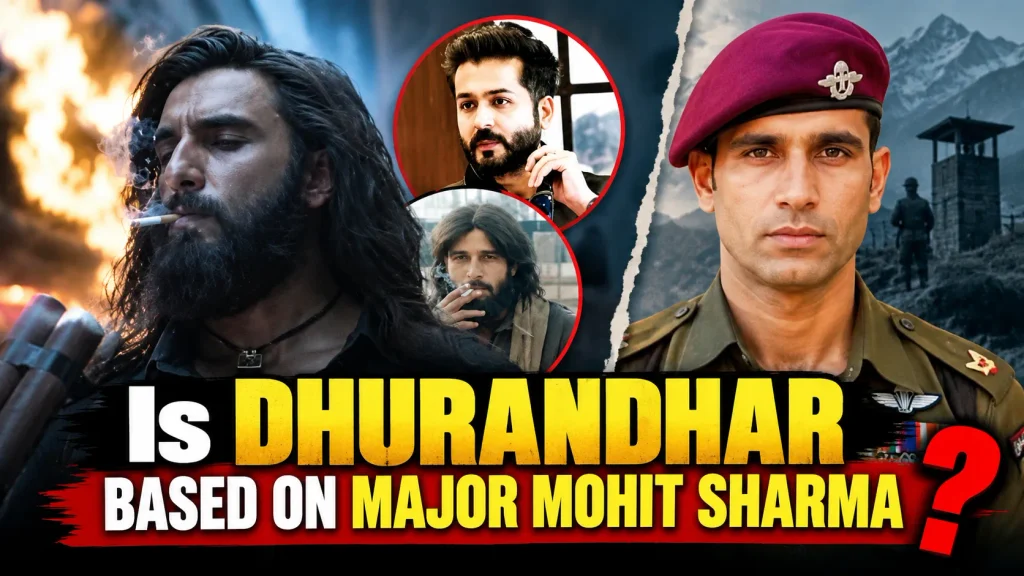
No confirmed evidence establishes that Dhurandhar is a biographical film about Major Mohit Sharma.
The speculation grew because the film’s themes and its undercover character led viewers and media reports to compare parts of the story with Sharma’s publicly reported career. His use of the Iftikhar Bhatt identity was one of the main reasons for the comparison.
Director Aditya Dhar later publicly denied that Dhurandhar was based on Sharma’s life. Indian Express reported that Dhar said a future film specifically about Sharma would involve the family’s consent and consultation.
So the safer description is that public discussion has compared elements of the film with Sharma’s story, while the director has denied that the film is based on his life.
Major Mohit Sharma vs the popular online version
| Topic | Research-supported position |
| Army career | Confirmed through multiple published sources |
| NDA in 1995 | Reported by established news sources |
| Commissioned in 1999 | Reported by established news sources |
| 1 Para Special Forces | Confirmed in military award records |
| Iftikhar Bhatt identity | Reported by established news sources |
| 2004 Hizbul Mujahideen infiltration | Reported by established news sources |
| Two militants killed during undercover mission | Reported by established sources |
| Sena Medal | Reported in career accounts |
| 2009 Kupwara operation | Confirmed by Government Gazette |
| Rescue of wounded soldiers | Confirmed by Government Gazette |
| Four terrorists killed in final action | Confirmed by Government Gazette |
| Chest wound during final action | Confirmed by Government Gazette |
| Ashoka Chakra | Confirmed by Government Gazette |
| Rajendra Nagar Metro station renamed | Reported and documented |
| Dhurandhar is a Major Mohit Sharma biopic | Not supported; director denied it |
How to understand Major Mohit Sharma’s story
There are two parts of his story that should not be treated in exactly the same way.
The first is his 2004 undercover mission. The broad account is supported by multiple secondary reports, but many detailed retellings go beyond what is available in the official military record.
The second is his final operation in 2009. That account has a direct government citation describing what happened and why he received the Ashoka Chakra.
For anyone researching Major Mohit Sharma’s real story, this distinction helps separate documented facts from later storytelling.
How to choose reliable sources about Major Mohit Sharma
If you’re researching Major Mohit Sharma for a blog, video or documentary-style article, start with the Government of India’s gallantry citation for his final operation.
For his career and 2004 undercover mission, compare multiple established news reports rather than relying on a single YouTube video or social media post.
Claims about exact dialogue, private conversations, hidden weapons, secret training or other dramatic moments should be checked against a primary source before being presented as fact.
FAQ about Major Mohit Sharma
Who was Major Mohit Sharma?
Major Mohit Sharma was an Indian Army officer who served with 1 Para Special Forces. He became known for counter-insurgency operations, including a reported 2004 undercover mission using the identity Iftikhar Bhatt. He was killed during an operation in Kupwara on 21 March 2009 and received the Ashoka Chakra posthumously.
What was Major Mohit Sharma’s Iftikhar Bhatt operation?
In 2004, Sharma reportedly infiltrated a Hizbul Mujahideen group while using the identity Iftikhar Bhatt. He presented himself as someone hostile to the Indian Army and gained access to the militant group. Published accounts say he gathered information and killed two militants during the mission.
How did Major Mohit Sharma die?
Major Mohit Sharma died during an operation in Kupwara on 21 March 2009. According to the official Ashoka Chakra citation, militants opened fire from three directions, four commandos were wounded, and Sharma rescued two of them. He was later shot in the chest but continued directing his team and killed two more terrorists in close combat.
Why did Major Mohit Sharma receive the Ashoka Chakra?
He received the Ashoka Chakra posthumously for his actions during the March 2009 Kupwara operation. The official citation records that he rescued wounded soldiers, killed four terrorists and continued leading his men after suffering a chest wound.
Was Major Mohit Sharma a Para Commando?
Yes. Major Mohit Sharma served with 1 Para Special Forces. Published accounts say he volunteered for the Para Special Forces and joined 1 Para after earlier service with 5 Madras and 38 Rashtriya Rifles.
Is Dhurandhar based on Major Mohit Sharma?
The director of Dhurandhar, Aditya Dhar, has denied that the film is based on Major Mohit Sharma’s life. Comparisons arose because some aspects of the film’s undercover storyline reminded viewers of Sharma’s reported work as Iftikhar Bhatt.
Where is Major Mohit Sharma remembered?
The Rajendra Nagar Metro Station in Ghaziabad was renamed Major Mohit Sharma Rajendra Nagar in 2019. The station is on the Delhi Metro Red Line.
Which one should you pick?
If your goal is to understand the documented military record, start with the Government of India’s Ashoka Chakra citation. It gives the clearest public account of Major Mohit Sharma’s final operation.
If you’re researching the Iftikhar Bhatt story, use several established reports and clearly separate confirmed facts from secondary accounts.
If you’re researching the Dhurandhar connection, treat it as a comparison or public controversy rather than calling the film a biopic. The director has explicitly denied that the film is based on Sharma’s life.
Major Mohit Sharma’s story remains notable for two very different parts of his service: the reported undercover mission in 2004 and the documented final battle in Kupwara in 2009. The second has a clear official record; the first needs more care when individual details are presented as fact.
Disclaimer: The detailed account of Major Mohit Sharma’s 2004 undercover mission is based on publicly available secondary reports, as no publicly available primary government citation was found documenting the operation in full. The official Gazette citation used for this article primarily documents his 2009 Kupwara operation and Ashoka Chakra award.
SOURCE: Nitish Rajput Channel


Leave a Reply
You must be logged in to post a comment.