
It is now ubiquitous that Cloud Computing is part of the enterprise IT infrastructure. Cloud platforms host websites, applications, databases, APIs and a vast array of other services for companies. However, these workloads aren’t about to eliminate the need for networking. Despite the variety of each of these applications, they all require a dependable means to communicate with the user, servers, databases and different services.
This has made the requirement for cloud networking experts great.
But a cloud network engineer requires more than just a network of routers and switches. Today’s role, includes virtual networks, cloud security, routing, hybrid connectivity, automation, Kubernetes and network monitoring. In larger environments, engineers might even end up needing more than one cloud provider.
Containers and AI workloads also make a difference to the cloud networking space. CNCF Annual Cloud Native Survey found that 82% of users of containers were using Kubernetes in production, January 2026.
When you find yourself wanting to obtain a career within the cloud networking, network engineering, cloud architecture, DevOps or infrastructure career fields, knowing exactly what topics and abilities to discover in the right order can help you get a leg up.
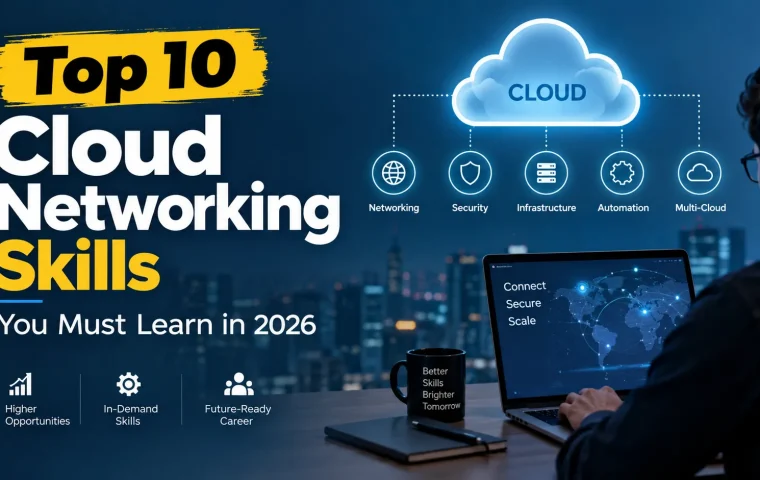
Below are the top 10 cloud networking skills to learn in 2026.
What are Cloud Networking Skills?
Cloud networking skills encompass knowledge and hands-on competencies in Building, Managing, Securing and Troubleshooting Networks on Cloud Platforms.
The fundamental concepts are the same as networking normally done. IP addresses are still used with computers. Routes continue to be the focus of traffic. Service discovery is still done via DNS and firewalls are still used to manage traffic.
What has changed, is that a lot of the network components are now software based and managed via cloud platforms.
For instance, you can deploy a virtual network in one of those platforms and provision routes with AWS, Azure or Google Cloud, eliminating the need for a router purchase or setup in a data center. You don’t need a physical load balancer to be installed; a managed cloud load-balancing service can be used.
Cloud networking also introduces new areas like Infrastructure as Code, cloud API, private endpoint, container networking and multi-cloud connectivity.
This is why it is essential for a cloud network engineer to be proficient with both networking and cloud technologies.
1. Cloud Networking Fundamentals
The first thing you need to master is networking 101.
While this might seem obvious, many folks jump straight to AWS VPC, Azure VNet/Azure Virtual Network, or Kubernetes without first conceptualizing the network. This usually works as a black hole later on, as the basics of the networking still applies in cloud networking.
Learn the basics of how IP addresses are utilized and how devices communicate with each other. One must have a knowledge of both IPv4/IPv6 and Public/Private IP addresses. CIDR and Subnetting is also something to learn since network within a cloud is usually split into smaller subnets.
For example, imagine that you create a cloud network with the IP range 10.0.0.0/16. You may divide this larger range into smaller networks such as 10.0.1.0/24, 10.0.2.0/24 and 10.0.3.0/24. Now each sub net can be utilized for different portions of your Application.
Another aspect of network fundamentals is routing. A route is a type of instructions telling network traffic to which area should it get. Applications that reside in one application server wishing to access the database in another subnet requires the presence of the path between them.
DNS is also key. Typically, users don’t access services by their IP addresses, they access them by names. DNS managing to convert names like example.com to IP addresses, which are used in order for computers to locate the correct service.
Know and understand what NAT is, TCP, UDP, ports, gateways and firewalls. These all seem like simple things, but we’ll be using them time after time, working with cloud networks.
You might need to review the route, NAT configuration, firewall rules and DNS configuration of a private application server for example, if it cannot connect to an external API.
Networking basics like IP addressing, subnetting, routing, DNS and network protocols are part of the learning goals for Microsoft’s current Azure Network Engineer certification.
This is the most basic objective for this phase: to learn how traffic flows between systems.
After having this basic understanding, cloud networking architecture is easier to understand.
2. Virtual Private Cloud (VPC), Virtual Network (VNet) and Network Segmentation
Once you have grasped network basics, you are ready to know virtual cloud networks.
AWS calls it Virtual Private Cloud (VPC). There is a Virtual Network (VNet) in Microsoft Azure. Google Cloud also offers the VPC networks.
These services are simply differentiated by their names, but enable you to set up and administer your own private network for your cloud resources.
It is important to learn how a virtual network is segmented out and how communication is happening between each of the subnets.
Let’s think about an easy online app. That could be a load balancer that gets requests from users. You might have application servers, behind it. Your database could be located in a different private subnet.
The network may appear as follows:
User – Load balancer – Application server – Database
Not all the databases have to be directly accessible via the Internet. Indeed, it would be a security hazard to allow the Web to have direct access to the database itself.
Alternatively, you can put the database in a private subnet, and permit connections only from the application servers.
This is known as network segmentation. You partition the network into various segments and regulate traffic flow between the segments.
Segmentation is very useful to understand because cloud application typically has various layers. Here in each layer can differ demands for a network.
Also, Route tables, Internet gateways, NAT gateways, Peering and private connectivity are the essentials you must know. These are the features that determine how traffic accesses the cloud, exits the cloud and flows throughout the cloud network.
As of now, a considerable part of Microsoft’s AZ-700 objectives cover networking basics such as network segmentation, VNets, IP addressing, subnets, DNS, and routing with the networking infrastructure.
While teaching this skill, don’t just remember lists of names for cloud services. Try making a mini VPC or VNet yourself. Develop and implement Public and Private Subnets, Set routes and test routing between public and private subnets.
That practical task will enable you to understand the architecture so much better.
3. Routing, BGP and Hybrid Cloud Networking
Most of the time, a cloud network doesn’t operate in isolation.
There are lots of companies that already have their servers or applications in their very own respective data centers. Either they may migrate some workloads to AWS and Azure and retain the rest on-premises, or they may choose to stay all-in on EC2.
This results in a hybrid cloud.
An application server, for instance, could run on AWS, and a company could maintain its own data center with its customer database.
The traffic could be something like this:
User <> Cloud App <> VPN / Dedicated Connection <> Company’s Network <> Database
This arrangement requires knowing how to get in contact with one another.
This is where routing plays a very important role.
It’s important to know the functioning of route tables and traffic decision making in network. In simple environments static routes can suffice. Dynamic Routing is used in larger environments.
BGP (Border Gateway Protocol) is particularly helpful in inter-connecting various networks. Learning BGP immediately will not be necessary, however, you must appreciate the way BGP exchanges paths and how networks make path choice.
For instance, in the situation where a company has a private link from its data center to the cloud provider, BGP can be used to exchange the networks routes between the two parties.
Having a familiarity with VPNs and IPsec is also crucial. Site-to-site VPN can be used for setting up an encrypted VPN tunnel connection between a company network and cloud network via internet.
As of this writing, AWS’ current Advanced Networking certification guide covers Routing, VPN, Hybrid Connectivity, Direct Connect and Network Design.
VPN Gateway, Azure ExpressRoute, BGP, Virtual WAN are other networking topics that are in progress from Azure.
The following concepts become more important the more you work with enterprise cloud networks.
4. Multi-Cloud Networking
It is customary to have one cloud provider, however, some companies employ two or more.
A company could have its primary applications in AWS, its MS workloads in Azure, and some data or AI services in Google Cloud.
In this case, the networks have to communicate with each other.
This is referred to as multi-cloud networking.
The networking concepts are largely unchanged, but the setup is more complex as each cloud vendor will have its own set of services and configuration options.
Among the initial concepts you have to consider is IP addressing.
Imagine that an AWS network uses 10.0.0.0/16 and an Azure network also uses 10.0.0.0/16. When connecting these networks later, both networks have the same IP-range. The routers may not know which network a particular IP address belongs to.
This problem can be avoided if a good IP planning is brought about.
You must also know the things such as VPNS, cloud interconnect services, routing, DNS, security rule and latency and so on.
An example of this is a service in Azure that an application in AWS must access; there are choices to make, such as how will the connection be formed, what routes will the application use, how will the traffic be secured and how will DNS operate.
Hybrid and multi-cloud connectivity, Cloud VPN, Cloud Interconnect, IP address planning and network troubleshooting are all part of the learning elements in Google Cloud’s existing Professional Cloud Network Engineer certification guide.
Don’t need to be an expert in all three cloud providers at once. Put another way, study up on one provider appropriately and then determine the networking ideas they have in comparison to other platforms.
5. Cloud Network Security
Security becomes the big part of cloud networking.
Each connection between two systems involves a point of decision as to whether or not to permit the connection.
A web server for instance, might require traffic either via HTTP or HTTPS from the user. The web server can simply pass traffic on to the application server. The database could just as easily be limited to traffic from the application server.
This’s where using security groups, network security groups, network ACLs and cloud firewalls come in.
It is necessary to know the specific functions of each security control and the places or methods in which it should be used.
Knowing about Web Application Firewalls, DDoS protection, private endpoints, TLS and IPsec should also be a plus.
One of the common pitfalls is that since it makes the application easier to test, everything is made available. This can be a great way in dev, but will cause serious issues in production.
Instead, just permit the necessary traffic.
For instance, you have an Application Server which requires a connection to a Database on port 3306. You might have a rule to allow only the application server to make connections to that port because there’s no other need for other traffic to be allowed.
This is far safer than allowing the whole Internet to access the database.
Another concept and term to get familiar with is Zero Trust. The principle behind this is to not trust any user or system that is within a specific network. Identity, permissions and security policies should be interrogated for access.
Microsoft’s current AZ-700 learning goals are network security groups, Azure Firewall, WAF, DDoS Protection and Network Monitoring.
Security should not be thought of as a stand-alone issue for the cloud network engineer. There is tight linkage between network design and security decisions.
6. Kubernetes Networking
There has been a strong interest in the use of Kubernetes, particularly for containerized applications, in cloud infrastructure.
According to the January 2026 release of the CNCF Annual Cloud Native Survey, 82% of container users had deployed Kubernetes in production.
This makes it beneficial to learn networking in Kubernetes for cloud network engineers.
At first glance, Kubernetes networking can be confusing, as it has its own concepts.
An Application deployed in a cluster of Kubernetes can span over numerous Pods. These Pods must be able to talk to one another, and users outside the cluster should be able to touch the application.
Kubernetes Services are also a stable means of accessing applications despite Pod replacement or moving.
For instance an application may have some backend Pods. A Kubernetes Service can be used to create a stable endpoint to send traffic to the available Pods rather than sending users directly to individual Pods.
Also, you should be familiar with ClusterIP and NodePort services, LoadBalancer services.
Ingress is another key theme. It offers a method of redirecting external traffic (both HTTP and HTTPS) to services that are deployed in the cluster.
The Ingress API is accordingly frozen and Kubernetes documentation has suggested to use Gateway in newer development. Gateway API adds greater options to manage app traffic.
NetworkPolicy is an equally crucial Kubernetes networking resource.
Let’s say you have an application, that consists of a front-end, back-end, and a database. The frontend might need to communicate with the backend, the backend might need to communicate with the database. However you might not want a direct contact with the database in the Frontend.
If the network plugin that is used by the cluster supports this capability, then NetworkPolicy can enforce such rules.
It’s also important to know what CNI is—Container Network Interface. CNI implementation by Kubernetes networking is used to provide network connectivity to the Pods.
If you want to use Cloud Native Applications, then you will want to add Kubernetes networking to your Cloud networking.
8. Networking API’s with Python and Terraform
Cloud networks can grow huge, all too rapidly.
To make one network manually is not too difficult. Now consider creating similar networks for development, testing, staging and production between multiple regions.
It will require a significant amount of time to do all of this manually, and also pose a risk of error.
That is why Automation is getting to be a vital ability for cloud network engineers.
Python is helpful as it can communicate with the Cloud APIs and automate repetitive tasks.
For example, you could write a Python script that checks network configurations, collects information about resources or creates a report from network logs.
No in-depth programming skills are required, so you can get started simply! For many networking tasks, you can do with basic Python and knowledge of APIs.
Another benefit of Terraform is that it enables the creation of infrastructures that can be expressed with code.
You can write specification for your VPC, subnets, route tables and security rules using plain old syntax in a text file that specifies these resources, rather than using a cloud console.
You can then keep those files in Git and use them to create the same infrastructure again.
For instance there might be a Terraform configuration for:
VPC Private IP Cidr Block → Subnets Public IP Cidr Block → Subnets Private IP Cidr Block → NAT Gateway IP Cidr Block → Route Tables Protection IP Cidr Block
The design can be reused if the company requires the same design in another environment, rather than re-creating them.
Some of the components that are included in AWS’s current Advanced Networking certification objectives consist of advanced modern networking knowledge such as Infrastructure as Code, APIs, SDKs and automation.
Hence, many cloud infrastructure jobs no longer just require a networking specialist. It’s important to know how to make an automated network you can build.
DNS, Load Balancing and Traffic Management
DNS and load balancing are essential for nearly all mission critical cloud app.
DNS is the glue which enables the user and applications to discover services through names. User will no longer need to remember an IP address – they will use a domain name (example.com).
To be a cloud network engineer, you need to get the concept of DNS records and the use of public and private DNS.
It’s important to know about DNS forwarding, how DNS resolution works, health checks and DNS based traffic steering.
There’s also a lot of info on load balancing.
Suppose an application is made up of 3 servers. With this sort of setup it may be possible for a user to be connected directly to one server, and that server could get overloaded.
In this way, the load balancer can round robin load balancing among the available servers in the environment.
The flow is quite simple as follows:
You have users connected to Load Balancer then to Server 1
** → Server 2**
** → Server 3**
Health checks could also be used by the load balancer to tell whether a server is functioning correctly.
There is a need to understand the difference between layer 4 load balancing and layer 7 load balancing.
The primary data manipulated by layer 4 load balancing includes IP addresses, TCP/UDP ports, and so on.
Layer 7 load balancing supports application-level information like HTTP requests, hostnames and URL paths.
Say, traffic to /api could be redirected to an API service and traffic to /images to another.
The existing list of Azure’s AZ-700 objectives covers load balancing, Application Gateway, Front Door, health probes, TLS and traffic management.
These skills come particularly in handy if the apps are deployed across multiple servers, regions or cloud environments.
9.1 Network Monitoring and Network Troubleshooting
A network could be functioning great today and then experience problems later on.
A server may be unresponsive. A scheme might be altered. Traffic may be blocked by a firewall rule. The address returned by DNS might be incorrect. VPN may get disconnected.
This is why it is critical to monitor and troubleshoot cloud networking skills.
A solid network engineer can troubleshoot a network issue rather than haphazardly making changes.
Assume that an application is not able to connect to the database.
First, delete the hostname first to see if it can resolve. Then proceed to check the IP address. Then verify that the path from the application to the database is good.
Doing this, next verify the security rules and enable the necessary port.
If everything appears to be fine, consult the network log and monitoring information for the problem to determine if it is reaching the destination.
This is a step by step way to uncover the true root cause.
You can use tools to examine network traffic, like Wireshark and tcpdump. When it comes to connectivity issues and working with DNS problems, there are tools like ping, traceroute, dig and nslookup.
There are also cloud provider monitoring tools. There are services like VPC Flow Logs and CloudWatch that AWS offers. Azure offers network watcher and Azure monitor features. Google Cloud offers Network Intelligence Center, along with tools for network observability.
Network monitoring, logging & troubleshooting are a part of Google Cloud’s current Professional Cloud Network Engineer certification.
Monitoring is also helpful prior to a problem occurring. Network metrics and logs can have unusual network traffic, periods of high latency or other changes that may require attention.
The objective is not necessarily to look at a dashboard — it is to see what the network is doing.
High-Performance Networking and AI Infrastructure
AI introduces new challenges for the cloud and data centre network.
With many GPUs (or other accelerators) it can be used for large AI workloads. In these systems, a significant amount of information is frequently transferred at a high speed.
This requires high bandwidth across the network and low latency.
Technologies and concepts in this area are RDMA, InfiniBand, high performance Ethernet, GPU clusters, East-West traffic and congestion.
These are not concepts any AI engineer would need to understand to become an engineer.
As a network engineer you need to know how the infrastructure can communicate.
For instance, an AI system might consist of various GPU servers, all requiring data from each another. Excessive delay or inadequate bandwidth can negatively impact the overall workload if introduced through the network.
Not like a straightforward site where the majority of visitors might be served in a person-to-server design.
AI systems may produce massive traffic between the servers within the infrastructure. This is known as traffic east to west and vice versa.
CNCF also reports on the use of Kubernetes in AI in 2026. According to its survey, 66 percent of organizations that have generative AI models deployed are utilizing Kubernetes for some or all of their generative AI inference workloads.
If you’re just beginning, you should not begin with AI Networking, as it’s still something specialized. First things are networking, cloud architecture, routing, and security. With all those skills firmly under your belt, you can begin to learn more about how networks performs for GPU and AI workloads.
Cloud Networking Skills Roadmap for 2026
When you are new to cloud networking, it can be challenging to learn too much all.
Don’t neglect the traditional networking.
Understand how to use IP addresses and subnetting, TCP/IP, routing, DNS, NAT and firewalls. Take time with these topics so that they can comprehend the flow of traffic in a network.
Next, select the one cloud platform.
To begin, choose either AWS, Azure or Google Cloud. Understand how that provider is building Virtual networks, Subnets, Routing, Security controls, VPN connection and Load Balancer.
Then, step up to hybrid networking. Understand VPN, BGP and stand alone cloud connectivity.
Once you feel comfortable with those topics, then do Terraform and basic Python. This will teach you to make and manipulate networks in code, rather than by hand.
Next, learn about Kubernetes networking, including services, DNS, NetworkPolicy, CNI and Gateway API.
Lastly, pick a space you would like to apex in. It could be cloud security, network automation, Kubernetes, or multi-cloud networking, or AI infrastructure and SRE.
By giving you this level of order, you have a solid foundation from which to build to more complex concepts.
This is a comparison between AWS vs Azure vs Google Cloud Networking.
While there are various names to the networking services offered by the three major cloud providers, many of the networking concepts are the same.
Networking Area
| AWS | Azure | Google Cloud |
| VPC | VNet | VPC |
| Direct Connect | ExpressRoute | Cloud Interconnect |
| Site-to-Site VPN | VPN Gateway | Cloud VPN |
| Route 53 | Azure DNS | Cloud DNS |
| PrivateLink | Private Link | Private Service Connect |
| Transit Gateway | Virtual WAN | Network Connectivity Center |
| VPC Flow Logs are used in conjunction with CloudWatch. | Azure Monitoring – Azure Watcher / Azure Monitor. | Network Intelligence Center / Cloud Observability |
They offer different services – the basic networking ideas are the same on all the platforms. Today, AWS, Microsoft and Google Cloud have certification content on topics like network design, routing, connectivity, security, monitoring and troubleshooting.
If you are a beginner, don’t attempt to learn three of them at a time. Choose one platform and know it well.
Learning another cloud is much simpler after that as the basic concepts already have been understood.
Top 5 Cloud Networking Projects You Can Start in 2026
There is nothing like doing to learn, when it comes to cloud networking.
Your first project is to create three-tier application network. Create a load balancer, application servers and a database. Maintain private subnets for the application and database and manage which portions of the application communicate with each other.
In your second Project, you will build a hybrid cloud lab. Create a small network environment to simulate an on-premises environment and connect it to AWS or Azure through a VPN. Next, conduct test routing and connectivity between the two networks.
The third project has the option of working with Kubernetes. Running a basic front- and back-end app This is done using a Service to connect the components and then creating NetworkPolicy rules to allow Pods to communicate.
On the fourth project, you will build a full cloud network with Terraform! VPC, subnets, routes and security rules etc are not all created in the cloud console, but are all defined in code.
On the fifth project attempt to join together two cloud environments. One option is to use AWS and Azure. List IP ranges and routes, and how the connection is made, along with any security rules and DNS configurations.
Such tasks can additionally make handy entries to your portfolio for cloud networking/DevOps/infrastructure applications.
Top Cloud Networking Certifications for 2026.
While learning a certification is a great way to demonstrate your familiarity with a given cloud platform, it shouldn’t be a substitute for real-world experience.
The Azure Network Engineer Associate (AZ-700) is focussed directly on Azure networking. It is currently working towards core networking, hybrid connectivity, application delivery, private access, network security, monitoring and troubleshooting.
In the case of Google Cloud, the Professional Cloud Network Engineer certification includes VPC networks, network designs, routing, hybrid and multi-cloud, security, monitoring and troubleshooting.
An important change is coming for AWS in 2026. AWS has announced that the exam “AWS Certified Advanced Networking – Specialty” will be retired at the end of December 31, 2026, as per the schedule. If you are seeking to become an AWS network certification, it’s best to review AWS’s current certification information before you begin studying for it.
The most appropriate certification to choose will depend on the cloud platform that the companies you wish to work with employ.
What it takes to become a Cloud Network Engineer in 2026
You can’t and don’t need to become an expert in all cloud technologies before seeking your first job in cloud networking.
Keep learning about the network basics – make sure you know about IP Addresses, Subnetting, Routing, DNS or firewalls.
Then select AWS/Azure/Google Cloud and study about the networking services provided by them.
Then do some practice building your own networks. Design public and private subnets, set up and test routes between different resources.
After knowledge of basics of cloud networking learn about VPN and hybrid connectivity. Next, throw in security, monitoring and troubleshooting.
The next stop should be automatic! Know Terraform and have a minimum understanding of Python for automation and API access.
Next, move on to Kubernetes networking when you’re looking into a career with cloud-native apps.
Lastly, create some builds and record your creations! Having a project that demonstrates how you created a VPC with another network and automated it will be more helpful during an interview versus just stating that you have taken a course.
Some of the typical pitfalls and mistakes that people make in learning cloud networking.
A way to start off wrong is to learn cloud services without networking. If you know what an AWS VPC or Azure VNet is, that doesn’t necessarily mean you know cloud networking. Needs to understand the rationale behind the design of the network.
One mistake is not employing subnetting. Subnetting can be confusing for some novices and they tend to avoid it. That can lead to trouble later on, since IP planning and design of subnets is used frequently in cloud networks.
The learning of AWS, Azure and Google Cloud together can also slow you down. Begin with one provider and get strong relationships going.
One important thing you don’t want to do is neglect security. Just because all the applications can communicate does not necessarily mean a well-designed network. You have to identify users access to resources and what sort of traffic into and out of each resource should be permitted.
An error to make is to go through all of the work by yourself. Resources are easily created from a console in cloud platforms, but this may not be enough in actual environments, and repeatable configuration and automation can be required. Knowing how to write Terraform and APIs, plus some basic Python, can help you get out of that manual grind.
Last but not least, do not depend solely on courses and tutorials. Build networks yourself. Make mistakes. Troubleshoot them. Remove a route and find out what breaks. Deny access to port and determine issue. The following exercises will give you an idea of how cloud networks behave.
Frequently Asked Questions
Will cloud networking be a valuable skill to acquire in 2026?
Yes. Networking still is at the heart of the things that cloud applications communicate with each other: users, servers, databases and services. AWS, Azure and Google Cloud still have networking, connectivity, security & troubleshooting as key subjects in their existing Networking Certification Programmes.
Is it necessary to have networking knowledge these days before picking up the cloud approach?
Yes. IP addressing, subnetting, routing, DNS, TCP/IP, NAT, and the basics of getting a firewall and understanding it are fundamental networking components that you should be familiar with before you get into more advanced networking in the cloud.
What will be the best cloud platform to start with?
Choose the cloud platform relevant to your career goals. All three cloud providers AWS, Azure and Google Cloud have solid networking services. Learning one platform is easier once you get a handle on one.
Kubernetes, should I learn networking?
When dealing with containers, DevOps and running cloud-native applications, it is also a good thing to know about Kubernetes networking. Kube-sphere has already been deployed in production, according to CNCF, 82% of container users reported using Kubernetes in production for their 2026 survey.
Do cloud network engineers need Python?
Knowing some basic python can be very useful. It can be used to interface with cloud APIs, automate repetitive jobs, and inspect configurations and process network information. This isn’t an advanced programming project, so it’s no problem getting started.
Why is Terraform significant for Networking in the Cloud?
Yes. You can use the Terraform to build and apply cloud infrastructure as code. Great for use when needing to replicate a network design across a number of environments.
Does BGP still have a role to play in cloud networking?
Yes. BGP is especially applicable for hybrid cloud and enterprise networking. It is important to have an understanding of BGP route exchange and the routing decision process.
If I’m interested in a cloud networking career, where do I start?
Begin at the basics of networking. Then on to a single cloud platform and then cloud security, hybrid networking, monitoring, automation and Kubernetes networking.
Final Thoughts
Cloud networking has come a long way, but the basics of networking remain the same.
There are still concepts such as understanding IP address, subnetting, routing, DNS, firewalls. The difference lies in the creation and administration of these networks.
Today, cloud network engineers interact with virtual networks, cloud security services, VPNs, multi-cloud connections, Kubernetes, Terraform, APIs and monitoring tools. AI workloads also present new networking demands, particularly for systems requiring high bandwidths and low latency.
Here are just 10 of the cloud networking skills you can start to pick up in 2026, ranging from networking fundamentals to VPC vs VNet, routing, BGP, hybrid and multi-cloud networking, cloud security, Kubernetes networking, cloud networking automation, through to DNS and load balancing, and monitoring and troubleshooting, and even AI infrastructure networking.
Again, don’t feel like you need to know everything instantly.
First off, learn the networking fundamentals. Select the cloud platform you prefer. Construct and work through real-life projects and learn how to trouble-shoot them. As you establish your expertise, add automation, security, Kubernetes, and other advanced networking issues.
The best cloud network engineer will be the one who knows where a network should be flowing and can figure out how to control that flow and when something breaks, how to locate and know why. It’s the base you should use to build your cloud networking knowledge in 2026.

Leave a Reply
You must be logged in to post a comment.