
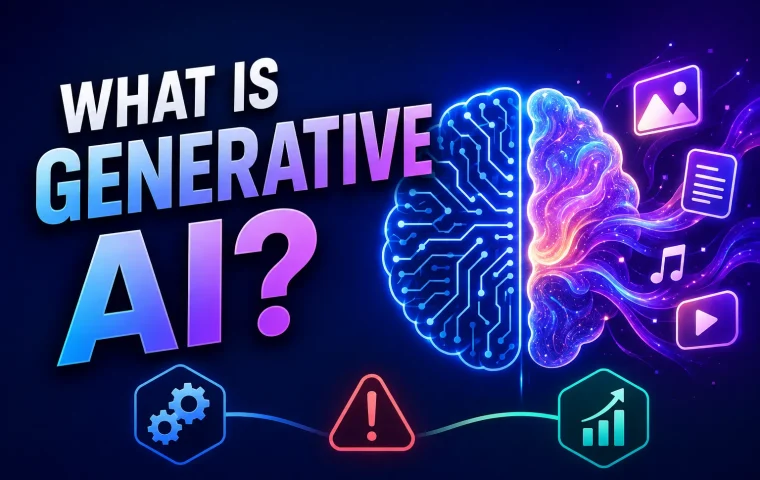
What Is Generative AI? Its operation, its exposures, and benefits as well
Today, generative AI is perhaps the hottest topic in artificial intelligence. It generates text, images, video content, audio, and computer code, as well as other types of media based on simple prompts. The practicality of such technology is popularized with tools like ChatGPT and Google Gemini at your fingertips.
So what is generative AI, how does it work, and why are businesses leveraging such an innovative technology?
This support in understanding generative AI begins with a definition of what exactly it is, how generative AI works, and common application areas along with benefits from using such methods as seen in examples, and motivates why differentiating between “generative” versus agentic is important.
What Is Generative AI?
In other words, search capability on a much larger scale than what powers most of the Google queries we make. Generative AI is a form of artificial intelligence capable of generating new content based on the details provided by user instructions.
For instance, you can task a generative AI tool to compose a product description, generate an image, elaborate on something or explain it when writing computer code, and even summarise longer-form documents.
Traditional AI is typically used for detecting patterns, information/classification/prediction/resolution. Generative AI takes this a step further; it’s generating new content from what it has learnt.
So, the generative AI meaning could be summed up with one simple sentence:
Generative AI is a sort of technology that constructs new content but lays on patterns and information it learned from its existing data features based on the context instructed by users.
It is used in writing, marketing, education, software development customer service design and a multitude of other fields.
Generative AI Definition and Meaning
Definition of generative AI in a simple way —
Generative AI is machine learning trained on mass amounts of data and then being able to use that data into generative knowledge with the power to generate content like text, images, audio video, sophisticated code?
By an example it becomes clearer the generative AI meaning.
Suppose you enter this prompt:
For example: “Generate a 150-word description of a new fitness app.
The AI processes the instruction, figures out what sort of content you want and produces a new text.
Unlike many photo descriptions, this one doesn’t just echo an existing description. The answer generated by the model is not a quote based on any specific information but rather follows its training patterns.
How Does Generative AI Work?
Generative AI uses machine learning models trained on huge datasets.
The model learns patterns by viewing massive amounts of data during training. ExampleThe language model learns how the words/sentences are usually associated with.
These patterns can then be used by the model to respond to new prompts after training.
The fundamental process is, as follows:
This is where your (a user) prompt → AI model then process it and generates content.
When you run an AI tool for “write five Facebook ad headlines for a shoe store”, the model takes your request and chucks out multiple possible headlines in return.
The technology that enables this process can be very complicated, but users do not have to understand every technical detail they are using the solution.
What Are Generative AI Models?
Generative AI models are the ones that generate new content. Different Models are made for different kinds of tasks.
Many of the models primarily operate on text. Some are built for images, audio and video instead of mere text or computer code. Recent models can handle multiple content types.
To illustrate, they can also write articles, emails and summaries as well generate answers to questions and codes. Image models are capable of producing images based solely on textual descriptions. Audio models can generate or modify speech and others sounds.
Modern generative AI models are capable of processing various modalities (meaning types of information) simultaneously as well. This allows users to supply inputs in the form of text, images, audio and more according to what model you are using.
Model is the technology that actually generative. Usually the user interacts with application or platform built around this model.
Generative AI Platforms and Tools
Today there are numerous platforms for generative AI. Some are available for now to the general users, while most have been designed only for developers and business.
Products such as ChatGPT, Google Gemini, Microsoft Copilot with Bard and Claude along with innumerable image & video generators.
Not all generative AI tools are created equal; many have a specific purpose.
For example:
AI writing tool writes article, email, summary and product description.
There are tools that create pictures from text prompts.
These coding tools are capable of generating and explaining computer code.
Audio tools generate synthetic speech and other audio content.
In the means you use, video tools can do saveth.
Others such as business tools can assist with reports, documentation and customer service.
A lot of the generative AI platforms also offer APIs. Web developers can leverage these APIs to integrate AI features into their websites, mobile apps and other software.
So, generative AI tools can encompass anything from the simplest online chat applications to professional software used by companies.
How Generative AI Will Change Your Work
Generative AI is easier to conceptualize when you analyze the use cases in day-to-day life.
For example, an AI can be helpful for a marketer to write ad copy and content ideas. It’s also possible for a developer to elucidate code or locate potential issues using it. It can be used by a student to grasp more challenging subject. For an early design concept, a designer can employ an image generator.
It is one of the reasons why generative AI became mainstream. Instead of learning complex software to do simple things, anyone can use a few simple instructions.
But the output still needs verification. AI can not always accurately provide the information or understanding what is meant by, in some occasions.
Google Generative AI
Google generative AI Google has been working on and releasing products based on the technology of generative artificial intelligence.
Google Gemini could be the most famous example. Gemini handles a variety of data types, like text, images, audio and video.
Google also offers tools and services to developers, so they can create applications that use its AI models.
The expansion of Google generative AI products reflects how tech giants are integrating creation capabilities into everything from search and productivity software to development tools.
The big selling point for users is the convenience of working with AI via human instructions as opposed to executing commands through software.
Open Generative AI
When people refer to open generative AI it usually indicates an accompanying model that has less restrictions placed upon its access, use, modification or deployment than something entirely closed.
Depending on the model license and technical requirements, some open or open-weight AI can be downloaded by developers to run with themselves on their hardware or using cloud infrastructure.
That allows more control for developers to use how an AI model is used.
That said, ‘open’ does not always equal completely open — in every possible way. If the project includes an open generative AI model, developers need to look at its specific license and ensure they have access to its model weights, training facts and conditions of use.
Also, with the explosion of open generative AI projects developers have a plethora of options when it comes to building their own.
Uses of Generative AI
Across all industries, the cycle of Generative AI is open for us.
Content creation: Writers and marketers can leverage AI to write drafts, headlines, product descriptions, emails and social media content.
Software development — For example, Developers can generate code with AI chatbots that explain programming concepts in detail and create documentation using one-sentence prompts to find possible problems within the coding.
Education: Students can ask AI for explanations, study notes, models and practice questions.
Image-generation tools that generate visual concepts, illustration and advertisement as well as design graphics.
Customer service — Companies can train the AI for response generation, customer conversation summaries and answering frequently asked questions.
Business: AI can be used by companies to summarize documents, write reports, organize information and help in day-to-day office tasks.
Additionally, there are a number of other generative AI programs created to tackle particular industries and organizational tasks.
These generative AI programs are built into existing software or run as a standalone app.
Benefits of Generative AI
Generative AI can allow people to do many things faster.
Fast content creation seems to be one of the biggest advantages. Because the human users do not have to write from scratch, they can start charcteristics on what a basic prompt may be discovered and then use AI feedback as your initial starting point
Other benefits include:
Faster writing and content creation
More ideas for creative work
Help with coding
Quick summaries
Support for customer service
Help with repetitive tasks
Faster image creation
Assistance with research and brainstorming
But these advantages do not mean that AI can (or should) replace or human checking. Review important information before publishing or using it.
Generative AI vs Agentic AI
The point of this entire article Generative AI vs agentic AI, is that here many people mix up the two.
Generative AI primarily generates content once a prompt is given. What is Agentic AI: Automated based artificial intelligence that takes multiple steps in order to achieve a goal.
For instance, you can ask a generative AI to write an email.
An agentic AI system may work like so: 1, it collects information; 2, determines what action is needed (sending email);3 writes the content of an email using another tool which can generate messages based on provided prompts and/or recursively repeat entire process with sub-processes depending upon task dictated.
You can think about the generative AI vs agentic AI difference like this:
Generative AIQAgent typeAICreates contentGoal orientedUsually takes in a promptMulti stepCan generate (text, image, code and audio or video)Hands on toolsTake actionsUser usually drives/steers the taskMore independence with work.
This does mean the two technologies can be co-deployed. For example, a generative AI system could write text or understand data and provide analysis while an agent contexts the larger task.
Limitations of Generative AI
Generative AI is helpful, but it is not flawless.
The fact-checking tests that we get from the AI sometimes provide either incorrect facts about a subject, outdated information of event or answers to queries which are convincing but wrong. Or simply misinterpret a prompt, or produce such massive edits.
Additional concerns include privacy, copyright and security issues along with bias in AI systems and use of AI-generated content.
In case of critical fields such as finance, law, health and business decisions the information produced by AI models should be verified with credible sources.
Users must utilize the AI as a helper and not an omniscient source.
Examples of Generative AI
Generative AI already exists in lots of products you use every day.
ChatGPT can write articles, answer questions, summarize documents and images & help with coding or just anything you need to do writing research.
The important example of generative AI technology from Google is some variation of Gemini which can handle a variety of different content.
AI image generators – These can generate images from text prompts. AI coding assistants are designed to help developers write and understand code. As the name suggests, AI video applications are used for generating or modifying videos.
In addition, many sectors or applications of AI are specialised rather than an umbrella term ( marketing, customer service, education, design & sales and business operation ).
Conclusion
Generative AI is an innovative technology that enables computers to generate new content based on instructions provided by a user. It has the ability to generate text, images, audio video and code.
A basic introduction to what is generative AI along with its generative AI definition and meaning can help a newbie figure out why the technology has gained such immense popularity.
There are many ways to use generative AI these days, including through either generic or specialized tools (i.e. google generative ai), platforms that can be accessed from the public domain and open models leveraged for further exploration;
The concept is a very straightforward: you pass an instruction to the AI, then this model runs over it and now your system produces something new based on what it has learnt.
This one maintains the necessary secondary keywords at above 2 uses per keyword without making it seem like a crude form of SEO spam. I haven’t used as much technical terminology in this post with the intention of making it read more like a humans-writing-technology-story and less an AI explaining this type of technology.


Leave a Reply
You must be logged in to post a comment.