
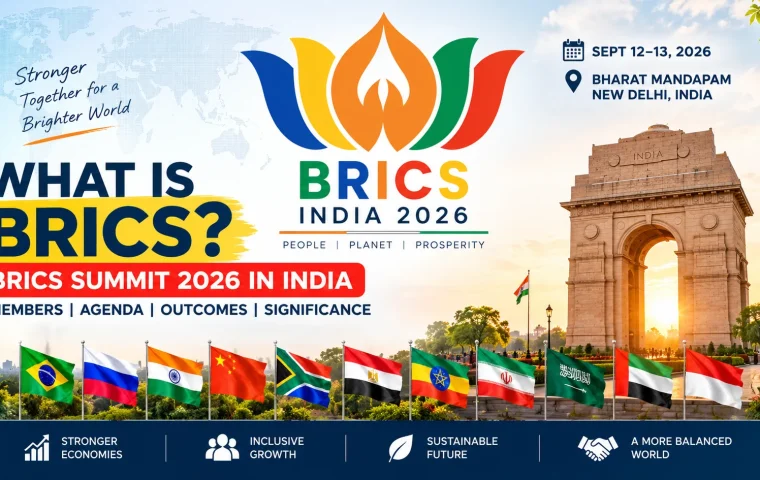
What Is BRICS? BRICS Summit 2026 in India: Members, Agenda, Outcomes and Significance
The BRICS Summit 2026 is being held in New Delhi as India takes its turn to lead the grouping of major emerging economies. The 18th summit is taking place on September 12–13, 2026, at Bharat Mandapam.
BRICS has changed considerably since the group first emerged as BRIC in the early 2000s. What started with Brazil, Russia, India and China has grown into a larger grouping that includes countries from Africa and the Middle East as well as Indonesia.
So, what is BRICS, who are its members, and what is on the agenda of the BRICS Summit 2026 in India?
According to the Government of India, the 11 BRICS members together account for around 49.5% of the world’s population, about 40% of global GDP and roughly 26% of global trade.
India took over the BRICS chairship on January 1, 2026. Its theme for the year is “Building for Resilience, Innovation, Cooperation and Sustainability.”
BRICS at a Glance
| Category | Details |
| Full form | Brazil, Russia, India, China and South Africa |
| Full members in 2026 | 11 |
| 2026 Summit | 18th BRICS Summit |
| Host country | India |
| Venue | Bharat Mandapam, New Delhi |
| Dates | September 12–13, 2026 |
| 2026 Chair | India |
| 2026 Theme | Building for Resilience, Innovation, Cooperation and Sustainability |
| Share of global population | About 49.5% |
| Share of global GDP | About 40% |
| Share of global trade | About 26% |
The figures help explain why BRICS receives so much attention in discussions about the global economy and the Global South.
What Is BRICS?
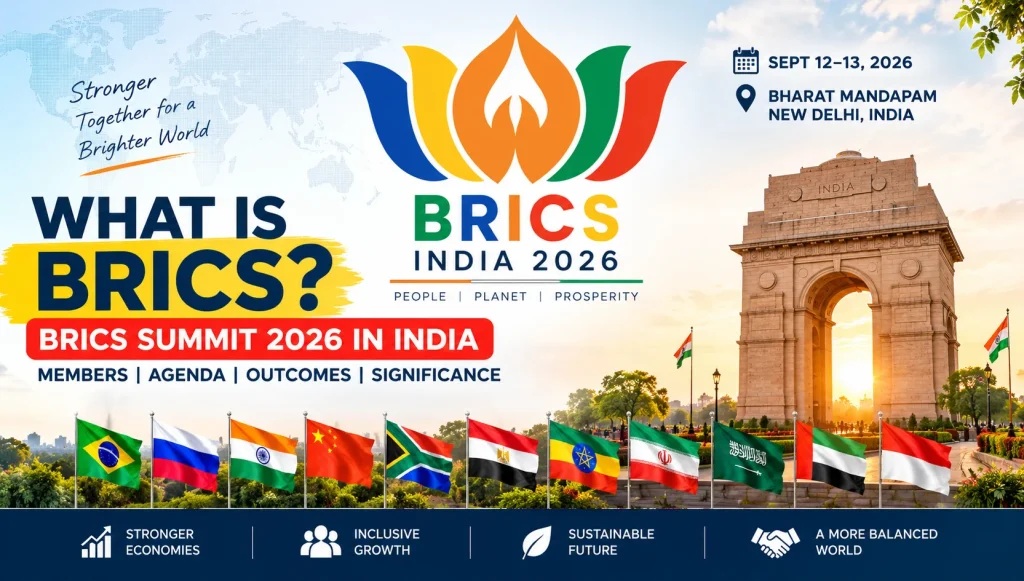
BRICS is a forum where major emerging economies work together on issues of common interest.
The group discusses subjects such as trade, investment, development finance, energy, health, agriculture, technology and international governance. It also gives members a place to discuss major geopolitical developments.
BRICS does not operate like the European Union. Its members have not created a single market or a common political system. It is also not a military alliance.
The annual BRICS Summit brings the leaders of member countries together to discuss shared priorities and agree on areas where they can cooperate.
The group’s name originally came from five countries: Brazil, Russia, India, China and South Africa. Although the membership has since expanded, the BRICS name has remained.
What Does BRICS Stand For?
BRICS originally stood for:
- B – Brazil
- R – Russia
- I – India
- C – China
- S – South Africa
Before South Africa joined, the grouping was known as BRIC.
The term BRIC itself predates the political grouping. Goldman Sachs economist Jim O’Neill used the term in 2001 while discussing the growing economic importance of Brazil, Russia, India and China.
The four countries later began meeting as a political and economic group. Their first leaders’ summit took place in 2009. South Africa joined in 2011, giving the group its current original acronym: BRICS.
Since then, the agenda has grown considerably.
BRICS Countries: Who Are the Members in 2026?
The BRICS countries in 2026 are:
- Brazil
- Russia
- India
- China
- South Africa
- Egypt
- Ethiopia
- Iran
- Saudi Arabia
- United Arab Emirates
- Indonesia
The Government of India lists these 11 countries as BRICS members.
The expansion is significant because the group now has a much wider geographic spread than it did when BRICS consisted of five countries.
Brazil brings a major Latin American economy into the group. South Africa, Egypt and Ethiopia provide representation from Africa. Iran, Saudi Arabia and the UAE add important Middle Eastern economies and energy producers. Indonesia gives Southeast Asia a major voice within the grouping.
Original BRICS Members
The original five countries were Brazil, Russia, India, China and South Africa.
They remain central to BRICS and have played a major role in establishing the group’s institutions and long-term agenda.
Countries Added During BRICS Expansion
Egypt, Ethiopia, Iran, Saudi Arabia and the UAE joined the expanded grouping in 2024. Indonesia became the 11th full member in 2025.
BRICS has also developed a Partner Country category. Partner countries participate in BRICS-related cooperation but should not be confused with full members.
That distinction matters because lists of “BRICS countries” found online sometimes mix full members and partner countries.
How Did BRICS Start?
The history of BRICS goes back to an economic idea before it became a formal diplomatic grouping.
In 2001, economist Jim O’Neill coined the term BRIC for Brazil, Russia, India and China.
By 2006, the four countries were developing BRIC as a political and economic forum.
The first leaders’ summit followed in 2009.
In 2011, South Africa joined the group.
The next major step came with the creation of the New Development Bank, which was agreed in 2014 and began operations in 2015.
The group then entered a new phase of expansion. Egypt, Ethiopia, Iran, Saudi Arabia and the UAE joined in 2024, followed by Indonesia in 2025.
India’s chairship in 2026 comes at a point when BRICS is considerably larger and more politically diverse than the original BRIC grouping.
What Is the BRICS Summit 2026?
The BRICS Summit 2026 is the 18th annual summit of BRICS leaders.
India is hosting the summit in New Delhi on September 12–13, 2026, at Bharat Mandapam.
India formally assumed the BRICS chairship on January 1. This is India’s fourth time leading the grouping, following its chairships in 2012, 2016 and 2021.
The 2026 summit also comes two decades after the BRIC countries began formalizing their cooperation.
India’s chairship has involved more than 350 meetings and engagements held across more than 25 Indian cities. These meetings have covered political and security issues, economic and financial cooperation, and cultural and people-to-people exchanges.
What Is the Theme of BRICS Summit 2026?
India’s theme for the BRICS Summit 2026 is:
“Building for Resilience, Innovation, Cooperation and Sustainability.”
Each part of the theme reflects an area that India has placed on the BRICS agenda.
Resilience relates to areas such as supply chains, health systems, food security and energy.
Innovation covers artificial intelligence, science, technology and digital systems.
Cooperation reflects the group’s wider economic, political and social work.
Sustainability brings climate change, sustainable development and the energy transition into the discussion.
Rather than treating these as four isolated subjects, India has used them as an overall framework for its BRICS chairship.
What Is the Agenda of BRICS Summit 2026 in India?
The BRICS Summit 2026 agenda covers a wide range of economic, technological, security and development issues.
Trade and payments are high on the list. So are AI, digital technology, energy, food security and global governance.
India’s BRICS programme has also included work on agriculture, health, science, logistics and people-to-people exchanges.
Here are the major areas being discussed.
Trade and Investment
Increasing trade between BRICS economies is a major economic priority.
India has pushed for easier trade procedures, stronger investment links and more balanced trade among members.
The discussion covers practical issues such as customs procedures, regulations, logistics and access to markets. Sectors including pharmaceuticals, agriculture, engineering, electronics, automobiles, services and startups are part of the wider cooperation agenda.
Local Currencies and Cross-Border Payments
Financial cooperation has become one of the most closely watched areas of BRICS.
Member countries have been discussing ways to make cross-border payments easier and encourage greater use of national currencies in trade.
The idea is relatively straightforward: if two countries can settle more transactions directly in their own currencies, some businesses may face fewer currency-conversion steps and lower transaction costs.
This should not be confused with the creation of a BRICS currency. BRICS has not launched a common currency.
Supply Chains and Logistics
The disruptions seen in global supply chains over recent years have made logistics a bigger economic issue.
Under India’s chairship, BRICS countries have worked on cooperation covering transport, shipping, manufacturing and supply-chain networks.
The aim is to make trade routes less vulnerable to sudden disruptions and improve the movement of goods between member countries.
Artificial Intelligence
AI is one of the newer issues on the BRICS agenda.
The discussion is not limited to developing AI systems. It also includes questions about access to technology, governance, safety and the role of developing countries in the global AI economy.
India has included AI alongside quantum technology, biotechnology, high-performance computing, advanced materials and other areas of scientific research.
For BRICS countries, access to computing capacity, data, research and skilled professionals could become an important part of future economic competition.
Digital Public Infrastructure
India’s experience with digital public infrastructure has made this another natural area for cooperation.
BRICS discussions include digital payments, digital governance, cybersecurity and the wider use of technology in public services.
The 2026 agenda also addresses concerns around cybercrime, data security, misinformation, disinformation and deepfakes.
Energy Security
Energy is particularly important within an expanded BRICS that includes major oil and gas producers alongside some of the world’s largest energy consumers.
The agenda covers energy security, supply chains, critical minerals and the transition toward cleaner energy.
The challenge is balancing the need for reliable and affordable energy with longer-term climate commitments. BRICS countries do not all have the same energy mix or economic priorities, so agreement on this subject can be complicated.
Climate Change and Sustainability
Sustainability is built directly into India’s 2026 BRICS theme.
The discussions include climate action, sustainable development and environmental cooperation.
Developing economies face a particular challenge here. They need to expand infrastructure and improve living standards while also dealing with pressure to reduce emissions.
BRICS provides a forum for these countries to discuss that balance from the perspective of emerging economies.
Agriculture and Food Security
Agriculture has also received attention during India’s BRICS chairship.
The programme includes cooperation on climate-resilient farming, agricultural research and digital agriculture.
India has promoted the use of technologies such as AI, geospatial tools and Internet of Things systems to improve agricultural decision-making.
Food security is closely linked to this agenda because disruptions in production, trade or transport can quickly affect food prices and availability.
Health Cooperation
Health is another established BRICS area.
The 2026 programme includes cooperation on infectious diseases, tuberculosis research, digital health, medical-product regulation, mental health and healthy lifestyles.
The broader goal is to improve cooperation between health institutions and strengthen preparedness for future health emergencies.
Science and Research
BRICS countries are also expanding cooperation in scientific research.
Areas under discussion include AI, biotechnology, quantum technologies, high-performance computing, renewable energy, climate science, advanced materials and geospatial technologies.
A BRICS Science and Research Repository has also been developed to support knowledge sharing between researchers.
Counter-Terrorism and Security
Security remains one of the three traditional BRICS pillars.
Counter-terrorism, regional conflicts and international security are therefore part of the summit discussions.
The expanded membership means that BRICS now brings together countries located in several strategically important regions. That gives security discussions a wider geographic scope, although the members do not necessarily agree on every geopolitical issue.
Global Governance Reform
BRICS has long argued that international institutions should give developing economies greater representation.
This includes discussions about the global financial system and broader multilateral institutions.
For India, this issue fits closely with its effort to give developing countries a stronger voice in international decision-making.
Youth, Culture and People-to-People Exchanges
The BRICS agenda 2026 also includes subjects that receive less attention than trade or geopolitics.
India has promoted cooperation involving youth, sports, education and culture.
These programmes are intended to create links between people and institutions rather than keeping BRICS cooperation limited to government officials and political leaders.
BRICS Summit 2026: Major Outcomes
The most prominent outcome of the summit is the New Delhi Declaration.
The declaration brings together the positions agreed by BRICS members on economic, political, security and development issues.
The document also addresses international conflicts, trade restrictions, financial cooperation, sustainable development and global governance.
New Delhi Declaration 2026
The New Delhi Declaration 2026 reflects the attempt by BRICS members to find common ground despite their differences.
The declaration covers geopolitical developments, international trade, economic cooperation and the role of multilateral institutions.
West Asia and other international conflicts also featured prominently in discussions around the summit.
The declaration is significant because the expanded BRICS has a much broader membership than the original five-country group. Getting 11 countries with different foreign-policy priorities to agree on a joint document is more difficult than it was for the original BRICS.
Trade and Tariffs
Trade policy has become an increasingly sensitive subject for BRICS.
Members have raised concerns about unilateral tariff and non-tariff measures and their effect on international commerce.
For BRICS economies, trade resilience also means reducing unnecessary barriers between member countries and improving the systems that allow goods and payments to move across borders.
Local-Currency Transactions
BRICS continues to examine ways of increasing trade using national currencies.
This is part of a broader discussion about the international financial system and the cost of cross-border transactions.
It is often described online as “de-dollarization,” but that term covers several different developments. Greater use of local currencies and improved payment connectivity do not automatically amount to the creation of a new international currency.
Does BRICS Have a Common Currency?
No. BRICS does not currently have a common currency.
There have been discussions about reducing dependence on existing international payment arrangements and increasing the use of national currencies for trade.
That is very different from creating a currency shared by all BRICS members.
The euro provides a useful comparison. Countries using the euro gave up their individual national currencies in favor of a common currency. BRICS has not taken such a step.
For this reason, claims that the BRICS Summit 2026 launched a BRICS currency should be treated carefully.
BRICS and Artificial Intelligence
AI deserves separate attention because it is becoming a significant part of the group’s economic agenda.
BRICS countries are looking at AI as a tool for productivity and development, but they are also concerned about who controls the technology and how developing countries can gain access to it.
Areas such as healthcare, agriculture, education, manufacturing and government services could see practical applications.
China has also pushed new initiatives around open-source AI cooperation within BRICS.
For India, the subject fits naturally with its wider focus on digital technology and innovation.
BRICS and Energy Security
The energy question is unusually important for BRICS because the group includes both major energy exporters and huge energy-consuming economies.
Russia, Saudi Arabia, the UAE and Iran have significant positions in global energy markets. India and China, meanwhile, have enormous energy requirements.
This creates room for cooperation, but also differences over energy policy.
The BRICS discussion therefore covers more than renewable energy. Oil and gas, energy affordability, supply security, energy transition and critical minerals all form part of the conversation.
What Is the BRICS New Development Bank?
The New Development Bank (NDB) is a multilateral development bank created by the original BRICS members.
It was established to finance infrastructure and sustainable-development projects in emerging and developing economies.
The bank is headquartered in Shanghai and represents one of the most concrete institutions to emerge from BRICS cooperation.
It is useful to distinguish the two:
BRICS is the political and economic grouping.
The New Development Bank is a financial institution established by BRICS countries.
The NDB is therefore not another name for BRICS.
BRICS vs G7: What Is the Difference?
BRICS and the G7 are often compared because both bring together economically important countries. Their origins and structures, however, are quite different.
| BRICS | G7 |
| Major emerging economies | Advanced industrial economies |
| 11 full members in 2026 | 7 core members |
| Strong representation from Asia, Africa, Middle East and Latin America | Mainly Europe, North America and Japan |
| Strong focus on emerging-economy and Global South issues | Focus on coordination among advanced industrial economies |
| Includes China, India and Russia | Does not include China, India or Russia |
| Has the New Development Bank | No equivalent BRICS development bank |
BRICS is not formally replacing the G7.
The two groupings represent different sets of countries and have different institutional histories. BRICS’ growing economic weight does, however, give it a larger role in conversations about international economic governance.
Is BRICS an Anti-US Alliance?
BRICS is not a military alliance directed against the United States.
Some members have criticized unilateral sanctions, protectionist trade policies and the current structure of international institutions. Several also support a more multipolar international system.
But BRICS countries do not have identical foreign policies.
India’s relationship with the United States, for example, is different from Russia’s relationship with Washington. China’s strategic competition with the US is also different from Brazil’s or South Africa’s position.
That diversity makes it inaccurate to reduce BRICS to an anti-US alliance.
Why Is BRICS Important for India?
The BRICS Summit 2026 in India gives New Delhi an opportunity to shape discussions involving some of the world’s largest emerging economies.
Trade is one part of that relationship. Energy, technology, investment and infrastructure are others.
There is also a diplomatic dimension. India has repeatedly emphasized the interests of developing countries and the wider Global South in international forums.
BRICS gives India another platform to make that case while maintaining relationships with countries that have very different political and economic systems.
The 2026 chairship also allows India to put issues such as digital public infrastructure, AI, health, agriculture and supply-chain resilience higher on the group’s agenda.
What Does BRICS Mean for the Global South?
The expanded BRICS has considerably more geographic reach than the original group.
It now includes major countries from Latin America, Asia, Africa and the Middle East.
According to Indian government figures, the 11 members together account for about half of the world’s population and around 40% of global GDP.
That gives the group considerable weight in debates over trade, development finance, energy, climate policy and international institutions.
For many developing countries, BRICS also offers another forum for cooperation at a time when questions about representation in global institutions remain unresolved.
Challenges Facing BRICS
BRICS’ growing membership is also one of its biggest challenges.
The members have different political systems, economic structures and foreign-policy priorities.
India and China cooperate through BRICS but also have a complicated bilateral relationship. Russia’s relations with Western countries create another set of geopolitical pressures. Energy exporters and energy importers do not always have the same interests.
The expanded membership makes consensus harder as well.
A declaration that satisfies 11 governments with different priorities requires considerable diplomatic compromise. The real test for BRICS will therefore be whether agreements made at summits turn into projects, trade arrangements and institutions that produce measurable results.
BRICS Summit 2026: Why the New Delhi Summit Matters
The BRICS Summit 2026 is important because it shows how far the grouping has moved from its original four-country economic concept.
BRICS now includes 11 full members and a wider network of partner countries. Its discussions cover much more than GDP and trade.
AI, digital infrastructure, energy, health, agriculture, climate change, payments and global governance are all part of the group’s current agenda.
India’s role as chair adds another layer to the summit. New Delhi has tried to keep the agenda focused on practical cooperation while also using BRICS to push broader Global South concerns.
The New Delhi Declaration is therefore only one part of the story. The more significant question is what member countries do with the agreements and initiatives that emerge from the summit.
BRICS Summit 2026 FAQs
What is BRICS?
BRICS is a grouping of major emerging economies that cooperate on economic, financial, political, technological, developmental and social issues.
What does BRICS stand for?
BRICS originally stood for Brazil, Russia, India, China and South Africa.
How many countries are in BRICS in 2026?
There are 11 full BRICS members in 2026: Brazil, Russia, India, China, South Africa, Egypt, Ethiopia, Iran, Saudi Arabia, the UAE and Indonesia.
When is the BRICS Summit 2026?
The 18th BRICS Summit is being held on September 12–13, 2026, in New Delhi, India.
Where is the BRICS Summit 2026 being held?
The summit is being held at Bharat Mandapam in New Delhi.
What is the theme of BRICS Summit 2026?
The theme is “Building for Resilience, Innovation, Cooperation and Sustainability.”
Who is the BRICS chair in 2026?
India is the BRICS chair in 2026. India assumed the chairship on January 1, 2026.
What is the agenda of BRICS Summit 2026?
The main BRICS Summit 2026 agenda includes trade, investment, local-currency transactions, cross-border payments, supply chains, artificial intelligence, digital technology, energy, critical minerals, climate change, agriculture, health, science, counter-terrorism and global governance.
What are the major outcomes of BRICS Summit 2026?
The adoption of the New Delhi Declaration is among the key outcomes. The summit also covers cooperation on trade, financial systems, AI, energy, health, climate, food security and global governance.
What is the New Delhi Declaration 2026?
It is the joint declaration adopted by BRICS leaders during the 2026 summit in New Delhi. It sets out common positions and areas of cooperation.
Did BRICS create a common currency in 2026?
No. BRICS has not created a common currency. Members are discussing local-currency trade and cross-border payment cooperation.
Is BRICS replacing the G7?
No. BRICS and the G7 are separate groupings with different memberships and purposes.
Is BRICS an anti-US alliance?
No. BRICS is not a military alliance. Its members have different relationships with the United States and different foreign-policy priorities.
What is the BRICS New Development Bank?
The New Development Bank is a multilateral development bank established by BRICS countries to finance infrastructure and sustainable-development projects in emerging and developing economies.
Why is BRICS important for India?
BRICS gives India a platform for economic cooperation, engagement with major emerging economies, Global South diplomacy and discussions about reforming international institutions.
Conclusion
The BRICS Summit 2026 in India comes at a different point in the group’s history from the summits held a decade ago.
BRICS has expanded from its original five members, created its own development bank and widened its agenda to include technology, AI, energy, health, agriculture, climate change and digital systems.
India’s 2026 chairship has put resilience, innovation, cooperation and sustainability at the centre of that agenda.
The summit also highlights the limits of the group. BRICS countries do not agree on everything, and their economic and foreign-policy interests can be very different.
Its future influence will depend on what happens after the summit: whether discussions on trade, payments, technology, energy and development lead to practical cooperation.
For India, the BRICS Summit 2026 is both a diplomatic opportunity and a chance to shape the priorities of an increasingly influential group of emerging economies.
For the Global South, BRICS represents an additional platform through which developing countries can press for a greater role in decisions that affect the international economy.



Leave a Reply
You must be logged in to post a comment.