
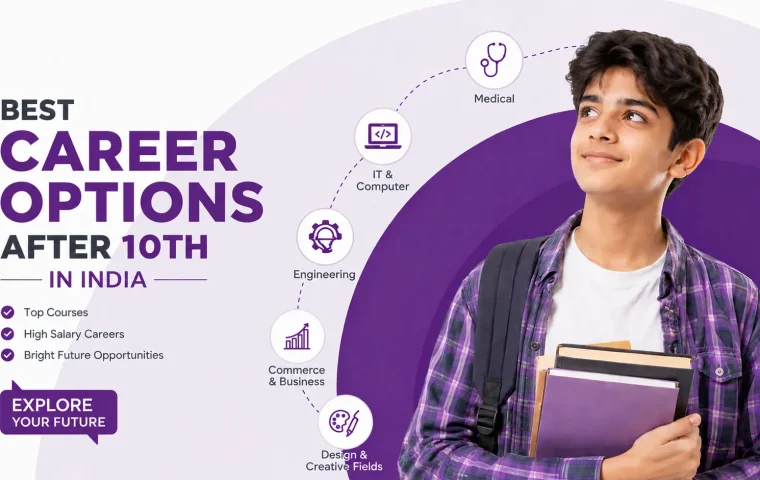
In this article, we have covered the Best Career Options After 10th in India, Courses and Career Guide.
Many students begin their thinking about the future after Class 10. They are also at a stage where they need to decide on a stream/course for further education.
Listening to others talking about how “Science is the best, Commerce is good for business, Arts has fewer career options”. However, these are not always the correct statements. These are all unique and the selection of the right one among them should depend on your interests, marks, skills, and the job you are planning to make.
Numerous career options after 10th are available for students in India. Science, Commerce or Arts/Humanities can be opted and further education can be pursued in class 11 and 12. It is also possible to go for ITI, Polytechnic, diploma or vocational courses.
This article breaks down the primary options so you can go into this decision with knowledge of what is to be expected.
Career Options After 10th in India
Now that students have completed their 10th, what are their career prospects?
Post Class 10 you would have following options:
- Science stream
- Commerce stream
- Arts or Humanities Stream
- Polytechnic courses
- Diploma courses
- ITI courses
- Vocational courses
Different careers can be associated with different options.
For instance, a pupil pursuing a career as a physician won’t follow the same course of study as one wishing to become an accountant, engineer, attorney, designer, or electrician.
Hence, first consider about the type of job you would like to do in future and then think about the answer to your question of which field is best after 10th.
Best Job Scope After 10th in Science
Students who are interested in Math, Phys, Chem and Bio are welcome to study Science.
Science is a subject a student can opt for in classes 10 and 11 onwards, depending on his/her future plans. Examples of common combinations are: PCM, PCB and PCMB.
Science with PCM
PCM stands for Physics, Chemistry and Maths.
It is a popular choice for students with an interest in engineering, computers, technology and Mathematics.
Further study may lead to employment in some of the following careers:
- Software engineer
- Computer professional
- Mechanical engineer
- Civil engineer
- Electrical engineer
- Electronics engineer
- Architect
- Data-related careers
- Scholarships for students interested in research and science-related fields.
For instance, if you want to be a Software Engineer, you can take upto Class 10 PCM, Class 12 and then study a relevant degree or course in Computer Science.
Science with PCB
PCB is short for Physics, Chemistry and Biology.
Students interested in medicine/health care and Biology often opt for this combination.
Some career options include:
- Doctor
- Dentist
- Nurse
- Pharmacist
- Physiotherapist
- Biotechnologist
- Medical laboratory professional
- Life science professional
To become a doctor it is necessary to take special school subjects, an entrance test and school for medicine. Admission requirements may vary; please be sure to review current requirements prior to applying.
Who Should Choose Science?
Science is good to pursue if:
You are good at Science-related subjects.
You have a good command of Mathematics or Biology.
You enjoy problem-solving.
- You are interested in technology, engineering, medicine or research.
- You are prepared to learn more in-depth about these subjects.
Don’t only do science because someone says that it is more useful than others. Science may not be easy if you don’t enjoy the subjects.
Career Options After 10th in Commerce
Commerce is mainly related to money, business, accounts, economics and finance.
Commerce could be a subject that students with a passion for numbers, business ideas and the functioning of companies will appreciate.
Curriculum subjects may include Accountancy, Business Studies, Economics and Mathematics for Commerce students, depending on the school.
Career after 10th in commerce – Options includes:
- Chartered Accountant
- Company Secretary
- Accountant
- Banking professional
- Financial analyst
- Business manager
- Marketing professional
- Entrepreneur
- Finance professional
- Economics-related careers
Chartered Accountant
Accounting, taxes, auditing and money management are the focuses for Chartered Accountancy.
CA is a professional course or students have to pass various level exams. Extensive study and preparation is required and students are advised to study the entire course before signing up for it.
Banking and Finance
If you need a job in the banking or finance industry, commerce is also helpful.
And then subject you can later use to study subjects like accounting, finance, economics or business and then apply for jobs or subject for business or professional in the areas.
Business and Entrepreneurship
If you are planning to start a business of your own later in life, in Commerce they can explain to you basic areas like accounts, business, money management and marketing.
But, it’s not essential to study Commerce to become a successful business owner.
Career Options After 10th in Arts
There are numerous career options after 10th in Arts.Career Options after 10th in Arts are many.
Usually referred to as Humanities, the study of Arts is recommended for students who love subjects involving people, society, history, politics, writing and communication.
The list of subjects available in this stream may include, but is not limited to:
- History
- Political Science
- Geography
- Sociology
- Psychology
- Economics
- English
- Other languages
Well, career options after 10th in arts are broad and extensive.
Later, one could progress to fields like:
- Law
- Psychology
- Journalism
- Teaching
- Civil services
- Social sciences
- Public administration
- Design
- Media
- Content writing
- Languages and literature
Law
After Class 10, you could select a good stream and then enlist for a Law Degree course by undergoing the proper admission process of it.
While Arts subjects can be useful to students planning to pursue studies in areas like Political Science, History and society, other stream students may also be able to study law, depending on entry requirements.
Psychology
Psychology may be a good area of career study if you are interested in the processes and behavior of people.
University students may study Psychology and pursue their studies in further education according to the job that they wish to have.
Civil Services
Student aspiring to work in government administration can afterwards prepare for the exams like the UPSC civil services examination.
Arts is not compulsory for civil services. Even students of science (or commerce) can prepare for such exams.
Diploma and Polytechnic Courses After 10th
It doesn’t mean that you have to take the normal Class 11 and 12 path.
After Class 10, students interested in technical work can opt for Polytechnic and Diploma courses.
Courses can be offered in some or all of the following areas, depending upon the college and state:
- Civil Engineering
- Mechanical Engineering
- Electrical Engineering
- Electronics
- Computer Science
- Information Technology
- Automobile Engineering
These tend to be more practical and technical courses.
A diploma may prove beneficial for those students that already have decided that they would like to pursue a course in a technical area. Some pupils may also be able to access higher-study pathways at a later stage that are appropriate to them.
Before undergoing admission, consult the duration of the course, cost of the course, college recognition and rules for further study.
ITI Courses After 10th
Students who like to get practical training may also choose to pursue ITI.
Students are trained in various trades in Industrial Training Institute. Some of the common examples are:
- Electrician
- Fitter
- Welder
- Turner
- Mechanic
- Electronics-related trades
- Computer-related trades
- Heating or drying of air (other than refrigeration and air conditioning)
- Draughtsman
The Directorate General of Training administers the Craftsmen Training Scheme, which comprises a wide range of ITIs and trades all over the country.
ITI courses may be beneficial to students who wish to acquire a practical skill that will lead into a technical / trade-focused pathway.
Connections to computers and the use of newer technology is present in several of what have been designated as training areas. But it’s not only traditional trades that can be done with ITI.
When deciding which ITI to pursue a trade at check the following: Is the ITI eligible, how long does the course run, what does the course have to offer and what can be done following completion of the course.
Vocational Courses After 10th
Vocational courses have less emphasis on the general skills of a certain job.
Courses/subjects may include/relate to:
- Information Technology
- Healthcare
- Retail
- Banking and Insurance
- Marketing
- Agriculture
- Media
- Tourism
- Automotive
- Beauty and Wellness
- Artificial Intelligence
CBSE also has various skill subjects at the level of schools like IT, healthcare, media, agriculture and Artificial Intelligence.
These courses could be beneficial for students that prefer hands-on learning and wish to develop a particular ability.
After 10th, Which Course is Best?
There is no such course that is the best after 10th – many students searched for which course is best after 10th.
You will need to select a career you are interested in.
For example:
Aim for a position as a Doctor?
Typically, it’s the path of Science with Biology.
Interested in engineering?
Technical diploma (science with mathematics or appropriate technical diploma) or similar may be considered.
Interested in an accountancy or finance career?
Advertising and sales can be an appropriate option.
Interested in employment in the business world?
Business is a skill you can learn through commerce but not the only way.
Perhaps you’d like to be a lawyer?
A “good” school stream can be selected then a law course taken later.
Interested in a technical trade?
ITI may be a good option.
Interested in studying Technical subjects after class 10?
Consider Polytechnic or diploma courses.
Ultimately, it’s what interests you and what you would like to do next.
Which Field is Best After 10th?
In fact, which field is best after 10th?Well, really, which field is best after 10th?
There is no determined, settled answer for which field is best after 10th.
Consider your likes and dislikes, strengths and weaknesses.
| Your Interest | Options You Can Consider |
| Mathematics and technology | Science PCM, Polytechnic |
| Biology and healthcare | Science PCB |
| Accounts and money | Commerce |
| Business | Commerce |
| History, politics and society | Arts/Humanities |
| Writing and communication | Arts/Humanities |
| Human behaviour | Arts/Humanities |
| Technical and practical work | ITI, Polytechnic |
| Computers | Science, Polytechnic, IT-related courses |
| Creative work | Arts, Design and related courses |
This is a straightforward & basic guide. There are alternate paths to some careers; Remove an asterisk from a career to see the requirements for the career.
How to Select Right Career After 10th
How to Select Right Career After 10th has been mentioned first.How to Select Right Career After 10th has been segmented initially.
If you are still unclear about what to select, then, do the following.
1. Take a Look at Your Favourite Points
Consider your favorite matters.
What are some subjects you like to learn?
Consider Science and technical courses if you like Mathematics and Science.
For those interested in Accounts/business topics, consider Commerce.
If you enjoy History, writing, Psychology or social subjects, look at Arts/Humanities.
2. Look at Your Marks
Your marks may indicate what areas of your course work you are proficient in.
Do not only choose a stream based upon one examination mark. Analise your work over a period of time.
3. Consider What You Wish to Accomplish
Make an attempt to visualize your future job.
Interested in computer work? People? Numbers? Machines? Patients? Businesses? Books? Design?
Don’t have to have a specific job defined yet. A general idea will suffice.
4. Investigate Education Requirements for Career
It’s a critical step.
Specific courses, or streams, may be necessary for some careers. However, others need entrance tests and degrees or professional courses to gain admission.
Please refer to the official rules of admission before making your decision.
5. Compare the Cost
Take into account tuition fees, coaching expenses, travel, hostel fees, and other expenses.
Don’t automatically think that a costly course will lead to the better career.
6. Consult with the Appropriate People
Speak to a teacher, career counsellor or someone for real who works in the career you are interested in.
Don’t rely solely on recommendations from friends or social media.
Common Mistakes Students Make After 10th
Students stand a good chance of making career decisions without taking into account the full picture.
Here are some errors that should be prevented.
Everybody says to study Science — not the right choice for all students.
Following your friend: Your friend might have other areas of interest and other talents.
Choosing a course only because of salary: Salary is contingent on education, skill, experience, company and location.
Always check which subjects, exams and qualifications are required, otherwise people may be ignoring course requirements.
There is no scope in Thinking Arts – Arts can take us towards law, psychology, media, teaching, civil services, etc.
Random selection of ITI/diploma course – institute, course, fee, training and future first.
Failure to plan for the future: Before choosing a course, research what courses you can take/do in the future.
Frequently Asked Questions
Following are the best career after 10th.Here are some best career after 10th.
After 10th major career options are: Science, Commerce, Arts/Humanities, Polytechnic, diploma, ITI and vocational courses. The right one depends on your liking and the purpose of your job.
What is the Best Course to Pursue After 10th?
“There isn’t one field that is best for all students.” Science can fit students who want to go into Engineering or Medicine –Commerce can fit students that want to involve themselves with finance and business –Arts can fit students that want to involve themselves with law, psychology, media and social sciences. ITI and Polytechnic can meet the demands of students opting for technical and practical work.
After Passing the 10th, What is the Best Course to Choose From?
Depending on your future plans, your course of study is best determined. Please make sure that you have investigated your chosen career and check the education, subjects and entry requirements for that job before selecting a course.
Can I Do ITI After 10th?
Yes. ITI admission is also open for the students who have passed class 10 in many ITI trade courses. But other commodities vary in eligibility so check current eligibility requirements before applying.
So After 10th Which is Better – Science or Commerce?
All streams aren’t automatically better. Different types of careers are available in Science and Commerce. Select the stream that aligns with your areas of interest, capabilities, and future goals.
What Are the Career Options After 10th in Science?
In future the career options after 10th in science can be an engineering course, medical field, computer field or IT, biotechnology or other science-related field, pharmacy, architecture or research etc.
What Are the Career Options After 10th in Commerce?
Business management, accounting, chartered accountant, banking, finance, economics, marketing and entrepreneurship are among the career options after 10th in Commerce.
What Are the Career Options After 10th in Arts?
Law, psychology, journalism, teaching, civil services, social sciences, public administration, media, design and languages are some of the careers options that students can pursue after finishing their 10th with arts.
Final Advice to Students
Making a decision on what to do at the end of Class 10 can be confusing without somebody to help you. Don’t hurry, don’t accept it because your pals are picking a specific course or due to the fact that somebody tells you that one course is much better than an additional.
Know what you want to do first of all. Next, check out your strengths and the careers that complement them. Research each career and its educational requirements and compare career courses available.
There are many useful options for studying for the future: Science, Commerce, Arts, ITI, Polytechnic, and vocational courses.Following any of these courses, Science, Commerce, Arts, ITI, Polytechnic and vocational, can lead to useful options, provided that right choice can be made and consistent efforts would be made by the student.
One doesn’t need to have everything done by the time they are 15 or 16 years old. All you need is enough information to make your approaching step sound.
Select one that you are familiar with, that fits you and that you have a means to progress.



Leave a Reply
You must be logged in to post a comment.